In Part 1 we looked at four everyday inputs that decide how well your mind performs: attention, movement, sleep and stress.
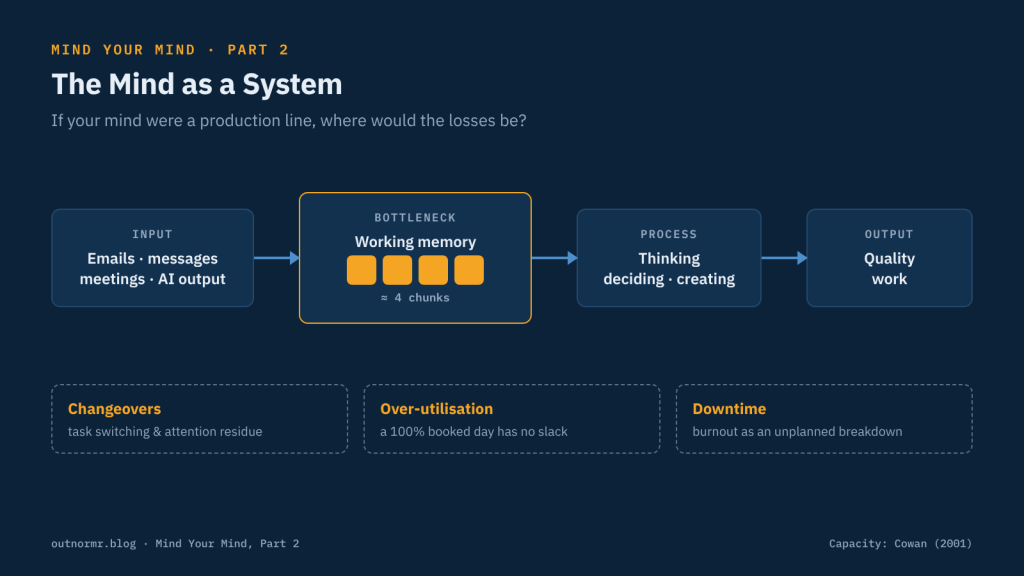
This week I want to look at the same mind through a different lens: the one I use every day on the shop floor. If your mind were a production line, how would an operations engineer assess it? Where is the bottleneck? How much time goes into changeovers? How close to 100% is it running? And what happens when maintenance is skipped?
The analogy isn’t perfect (people aren’t machines) but it’s surprisingly useful.
1. Capacity: a very small buffer
Every line has a bottleneck. In the mind, a strong candidate is working memory, the mental workspace where you hold and juggle information while you think.
It’s smaller than most people assume. Psychologist Nelson Cowan’s review of the research suggests it holds about four chunks of information at once, not the “seven plus or minus two” many of us learned.
In operations, the Theory of Constraints teaches a simple rule: an hour lost at the bottleneck is an hour lost for the whole system. The same applies here. Every notification, open loop and half-finished task occupies part of that tiny buffer.
Engineer’s fix: protect the bottleneck. Write things down instead of holding them in your head, keep one task in front of you, and close loops before opening new ones.
2. Changeovers: the hidden setup time
On a production line, switching from one product to another costs setup time. In the mind, switching from one task to another works the same way.
Research by David Meyer, Joshua Rubinstein and colleagues found that every switch has a time cost. It can be just a few tenths of a second, but it grows with task complexity and unfamiliarity, and it adds up when we switch back and forth all day. Meyer has estimated that heavy switching can cost up to 40% of productive time. That’s an estimate rather than a single measured figure, but the direction is clear.
There’s a second loss. Sophie Leroy, now dean of the University of Washington Bothell’s business school, showed that when we switch, part of our attention stays behind on the previous task. She calls it attention residue: like a machine still carrying traces of the last batch.
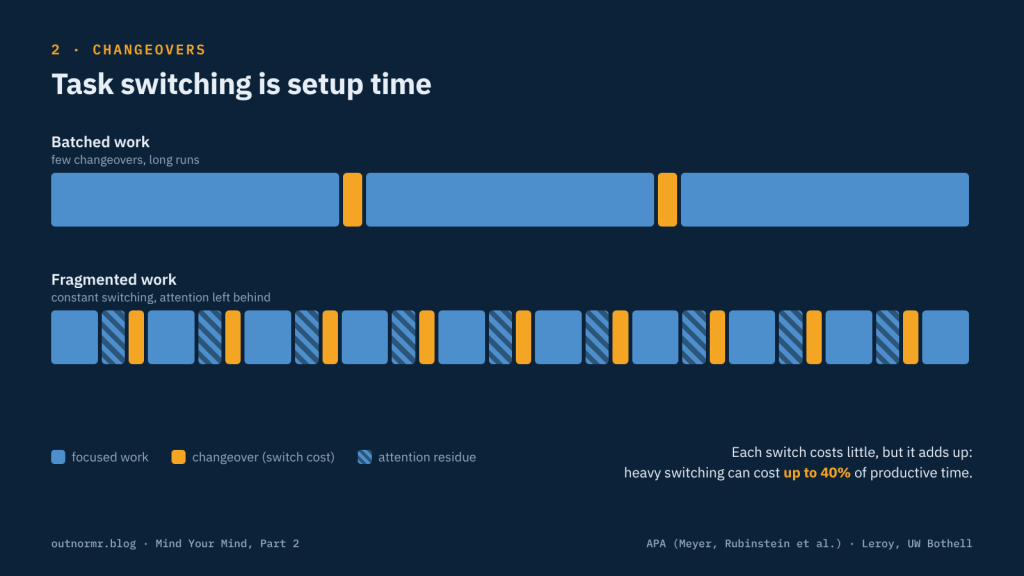
Engineer’s fix: apply SMED to your day.
- Batch similar tasks (all calls together, all emails together).
- Before switching, take one minute to note where you stopped and what’s next. Leroy calls this a “ready-to-resume” plan, and her research shows it helps the brain set the unfinished task aside.
3. Utilisation: why 100% booked means 0% flexible
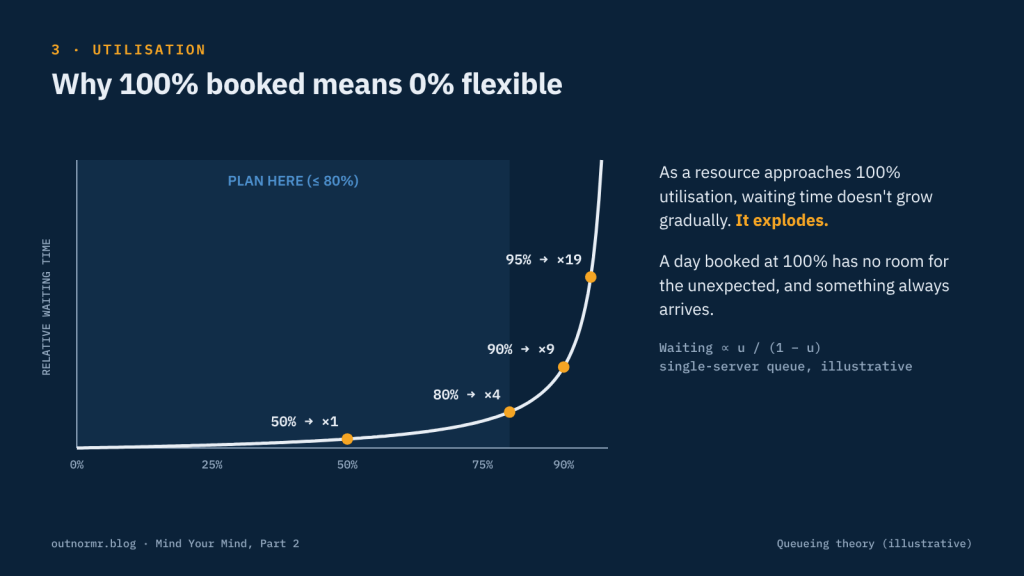
Any planner knows this from queueing theory: as a resource approaches 100% utilisation, waiting times don’t grow gradually, they explode. At 50% load a job waits about one unit of time; at 80%, about four; at 90%, about nine; at 95%, about nineteen.
Now look at a typical knowledge worker’s day. According to Microsoft’s 2025 Work Trend Index, people using Microsoft 365 are interrupted every two minutes by a meeting, email or notification, around 275 times a day, with an average of 117 emails and 153 Teams messages daily. Nearly half of employees (48%) say their work feels chaotic and fragmented.
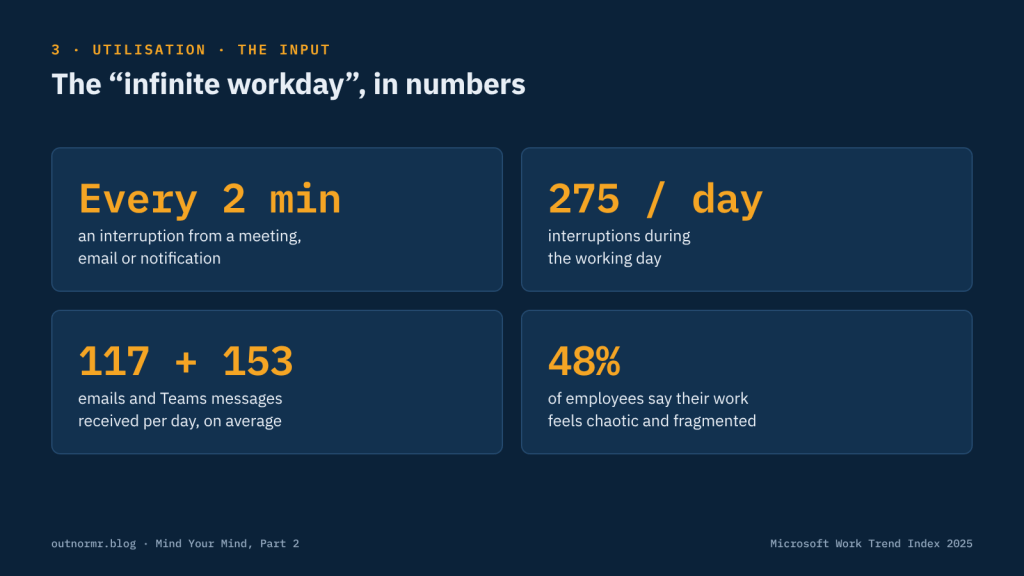
That’s a line running at full utilisation with a constant stream of rush orders. Nothing flows.
Engineer’s fix: plan your day to roughly 80%, not 100%. Keep buffer time for the unexpected, and turn interruptions into scheduled batches instead of a continuous feed.
4. Downtime: burnout is a breakdown, not a weakness
Every maintenance engineer knows the difference between planned and unplanned downtime. One is cheap and scheduled. The other is expensive and arrives at the worst moment.
The World Health Organization describes burnout in ICD-11 as an occupational phenomenon, not a medical condition, resulting from chronic workplace stress that hasn’t been successfully managed. It has three dimensions: exhaustion, increasing mental distance or cynicism toward one’s job, and reduced professional efficacy.
In plant terms: the machine slows down, starts producing defects, and eventually stops.
Engineer’s fix: Total Productive Maintenance for people. Sleep, movement and recovery (from Part 1) are your planned maintenance. Skip them long enough and the system schedules its own downtime.
5. The new input: AI floods the line
AI can draft, summarise and generate faster than any human can read. That’s powerful, but in system terms it can also mean more input arriving at the same small buffer.
Microsoft’s own report warns of the risk of using AI to accelerate a broken system. The opportunity is the opposite: use AI as an incoming quality filter that summarises, prioritises and removes noise before it reaches you, not as another source of noise.
The takeaway: OEE for the mind
In manufacturing we measure Overall Equipment Effectiveness as Availability × Performance × Quality. As a thinking tool, it maps neatly onto the mind:
- Availability: are you rested and present, or heading for downtime?
- Performance: how much capacity is lost to changeovers and interruptions?
- Quality: how many errors and rework come from a divided mind?
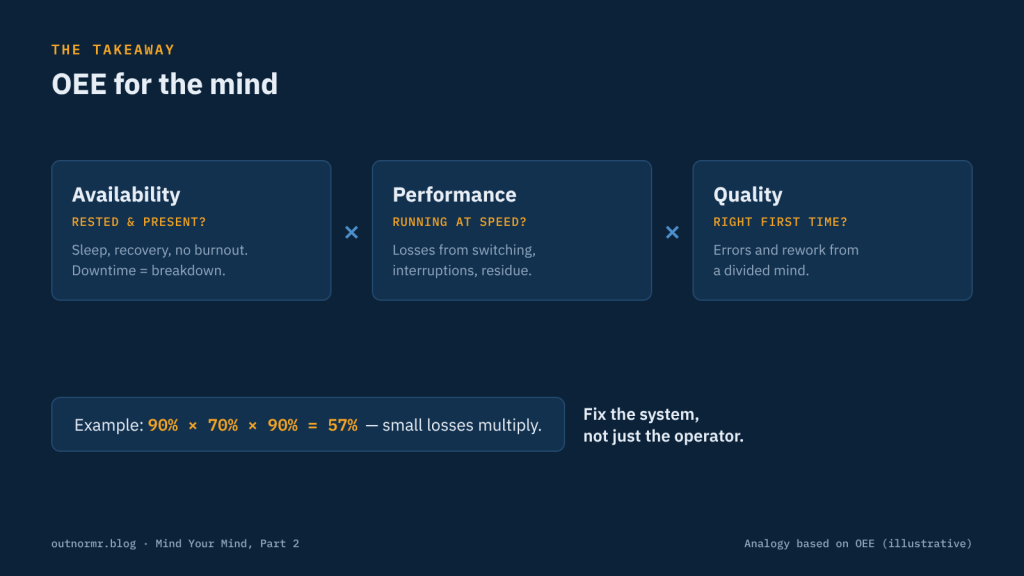
Just like on the line, a small loss in each one multiplies. Fix the system, not just the operator.
Next week, Part 3: Leaders & Engineers. What this means for teams, and what managers can change so their people’s minds aren’t running at 100% with no maintenance window.
This article is for general information and is not medical advice.
Sources
- Microsoft WorkLab — Breaking down the infinite workday (Work Trend Index 2025)
- Microsoft — The rise of the infinite workday (June 2025)
- APA — Multitasking: switching costs
- Rework — on Meyer’s 40% estimate
- UW Bothell — Sophie Leroy on attention residue
- UW Bothell — Fresh insights into workplace interruptions (ready-to-resume plan)
- Cowan (2001) — The magical number 4 in short-term memory
- WHO — Burn-out an “occupational phenomenon” (ICD-11)


Leave a Reply