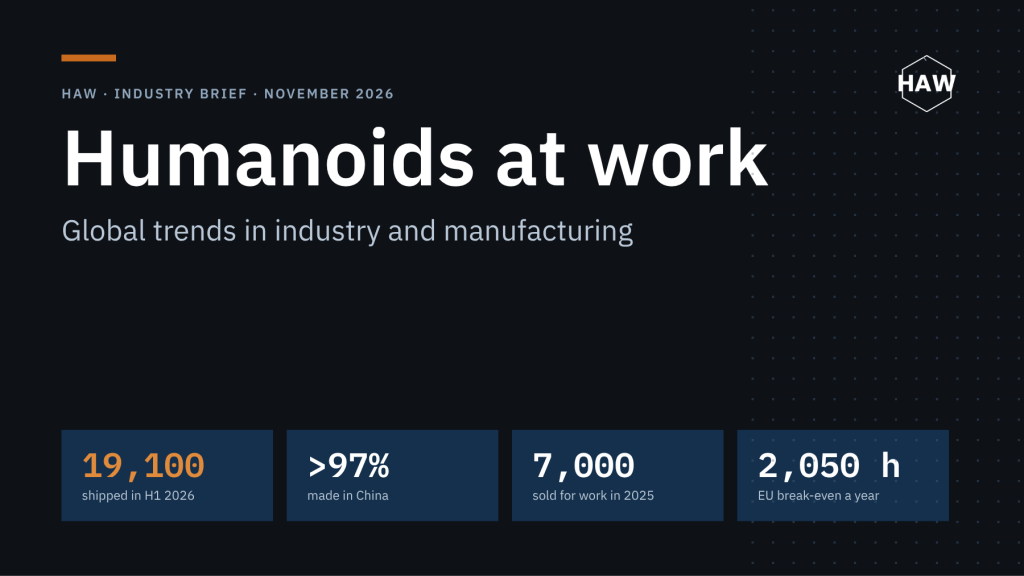
Humanoid robots are no longer a question of whether. They are being built by the tens of thousands, bought by carmakers and written into national industrial plans. The open questions are different now: how fast, where, for which jobs, and when they pay for themselves on a real shop floor.
In my last post, From the Stopwatch to the Agent, humanoids appeared near the end, as the newest chapter in 140 years of engineering work. This post zooms in on that chapter. It is a trend brief from a manufacturing engineer’s point of view: what the 2026 numbers say, who is actually deploying humanoids in factories, and what a plant should do about it.
2026 in five numbers
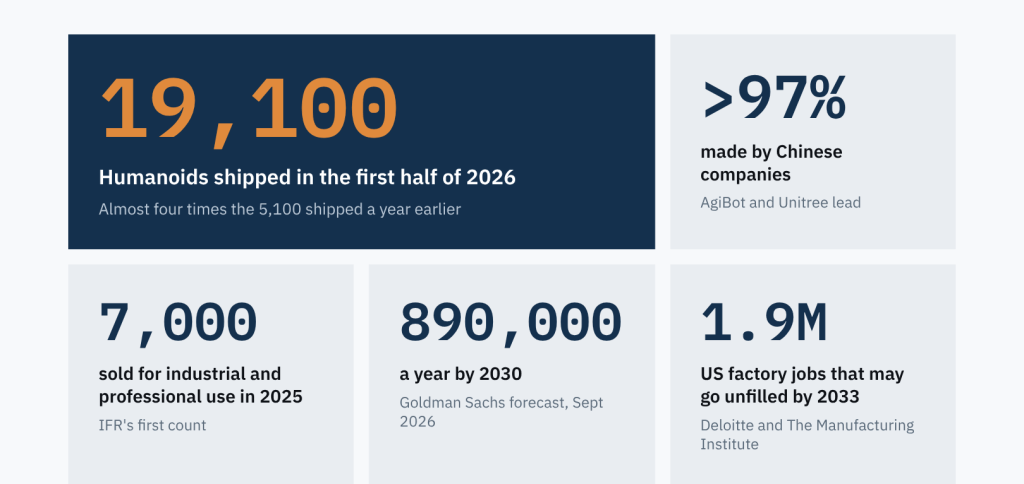
Put together, the numbers tell a simple story. Volume is real and growing fast. Factory use is still early. And the pull from a shrinking industrial workforce is strong enough that neither investors nor carmakers want to wait.
Shipments almost quadrupled in a year
About 19,100 humanoids were shipped worldwide in the first half of 2026, up from roughly 5,100 a year earlier. That is almost as many in six months as in all of 2025, when about 20,000 were built. Analysts expect 60,000 to 90,000 for the full year: three to four and a half times 2025’s volume.
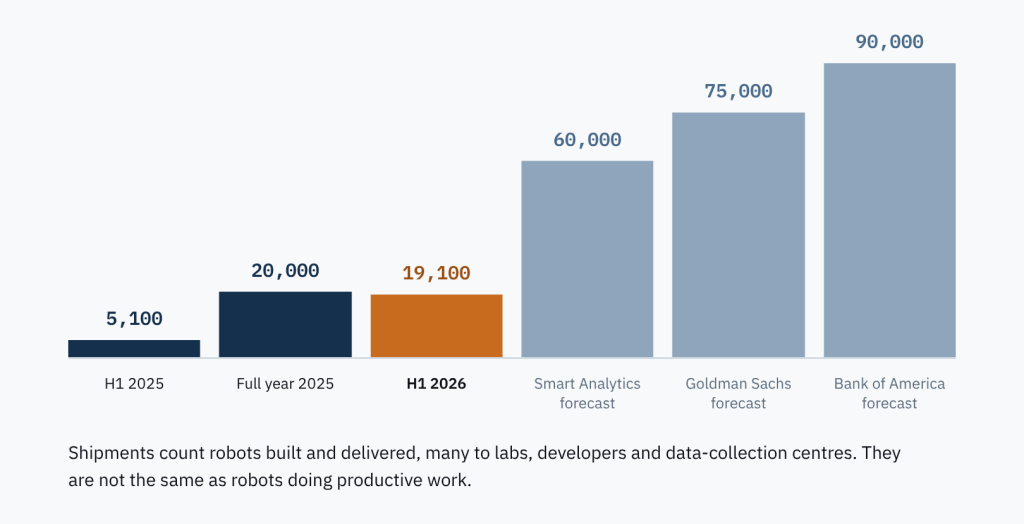
A caution before the excitement: shipments count robots built and delivered. Many go to universities, developers and the data-collection centres where robots are trained by teleoperation. They are not the same as robots doing productive work in a plant.
China builds almost all of them
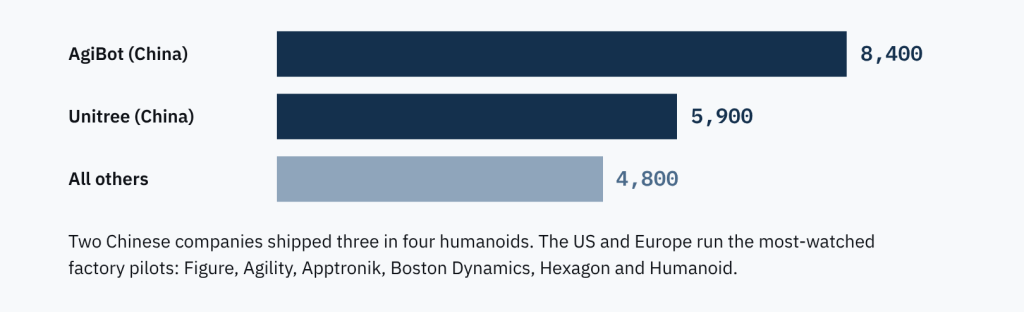
More than 97% of the humanoids shipped in the first half of 2026 came from Chinese companies. Two of them, AgiBot and Unitree, shipped about three in four.
Policy is part of the reason. In June 2026 China’s industry ministry and its state-asset regulator told local governments and state-owned companies to put more than 10,000 humanoids into commercial use by the end of the year, across manufacturing, logistics, retail, healthcare and emergency response. Chinese embodied-AI start-ups raised $2.9 billion in the first quarter alone.
The United States and Europe ship far fewer units but run the most-watched factory pilots, with Figure, Agility, Apptronik, Boston Dynamics, Hexagon and the British start-up Humanoid. The money is following there too. Figure is valued at $39 billion, and factories for tens of thousands of robots a year are going up: Hyundai plans capacity for 30,000 Atlas robots a year by 2028, and Figure’s BotQ plant is sized for 12,000. Capacity is not demand, though. Most buyers are still piloting.
Still about 1% of factory automation
Against the wider robot market, humanoids are still a rounding error. The International Federation of Robotics counted about 7,000 humanoids sold for industrial and professional use in 2025, its first such count. Factories installed 603,307 conventional industrial robots in the same year.
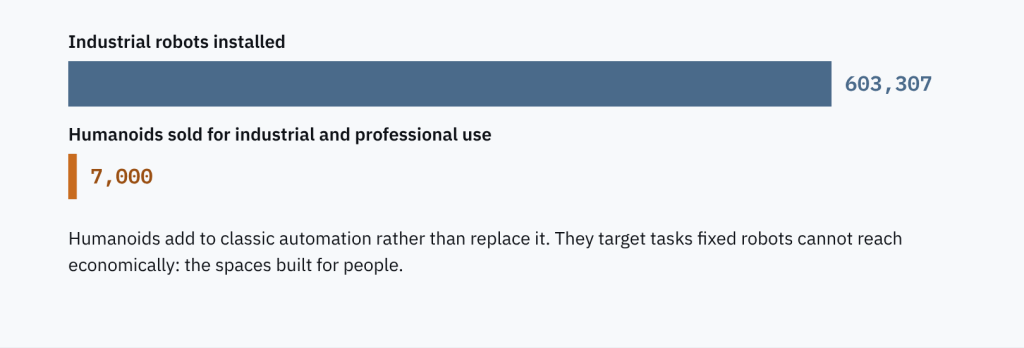
That gap matters for how to think about humanoids. They do not replace classic automation. A fixed robot or a conveyor will stay faster and cheaper for any stable, high-volume task. Humanoids target the jobs fixed automation cannot reach economically: spaces built for people, with carts, shelves and stations laid out at human height.
Who is putting them to work
Carmakers and their suppliers are the main industrial testers. Most programmes sit in the middle of the ladder: pilots and plans, not paid fleets.
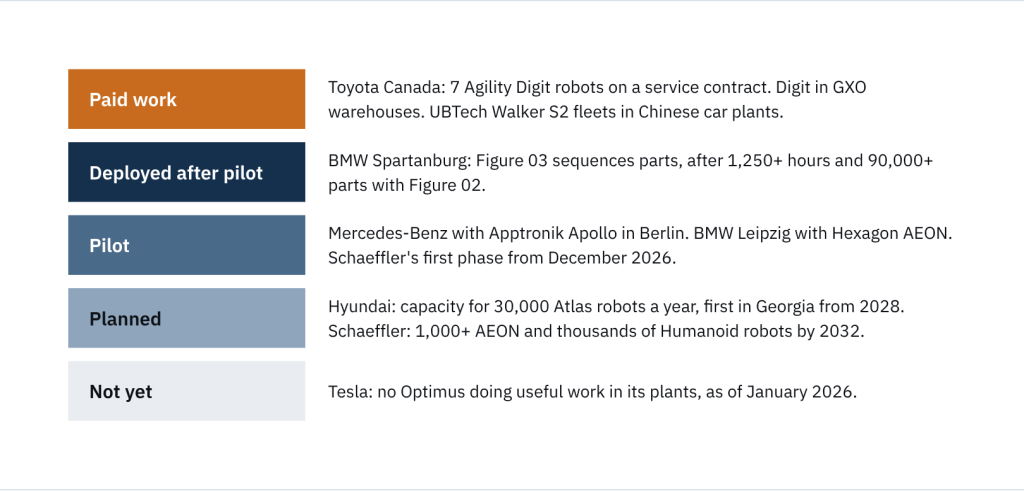
- Toyota and Agility. In February 2026 Toyota’s RAV4 plant in Canada signed a robots-as-a-service contract for seven Digit robots, after a year-long pilot. They unload totes of parts between two automated lines. Toyota pays for the work, not the machines.
- BMW and Figure. Figure 02 worked in BMW’s Spartanburg body shop for 11 months, logging more than 1,250 hours, loading over 90,000 sheet-metal parts and supporting the production of more than 30,000 X3s. In June 2026 BMW deployed the new Figure 03 for parts sequencing. In Leipzig it is testing Hexagon’s wheeled AEON.
- Hyundai and Atlas. Boston Dynamics launched the production version of Atlas in January 2026. Hyundai plans capacity for 30,000 a year and will start using them in Georgia from 2028, parts sequencing first, with component assembly targeted by 2030.
- Schaeffler. The German supplier has committed to at least 1,000 AEON robots by 2032, and signed a service deal for thousands of robots from Humanoid, starting in two German plants in December 2026.
- UBTech in China. Its Walker S2 has more than ¥800 million in orders from BYD, Geely, FAW-Volkswagen, Foxconn and others, delivered in phases.
- Mercedes-Benz. An investor in Apptronik, it is piloting the Apollo robot for intralogistics and first quality checks in Berlin.
- Tesla. In January 2026 the company said no Optimus robot was yet doing useful work in its plants.
What they do on the floor today
Look past the announcements and the tasks are strikingly similar:
- Tote and box handling: Toyota, GXO, Schaeffler.
- Parts sequencing: BMW with Figure 03; Hyundai’s first Atlas task.
- Machine loading: sheet metal into welding fixtures at BMW; load, unload and inspect at Schaeffler.
The pattern is one narrow, repetitive material-handling task, placed between existing automation, with people overseeing. Fine assembly, maintenance with tools and fast re-tasking from one job to another are still demonstrations, not deployed work. That is not a weakness to hide. It is the right place to start.
What slows adoption
- Cost. One illustrative estimate puts a Digit at about $200,000, or around $400,000 over five years, and Agility’s CTO says integration can cost more than the robot itself. The makers are not profitable yet: Agility reported $1.8 million of 2025 sales against a $140 million operating loss.
- Safety. A robot that balances can also fall. ISO 25785-1, the first standard for actively balancing robots, is still a draft, expected in late 2026 or 2027. Until then, plants work from ISO 10218 with a fall-zone analysis.
- Missing reliability data. No maker publishes uptime, interventions per hour or mean time between failures. Without them, no plant can build an honest business case.
- People. Employers expect 39% of core skills to change by 2030. As my last post argued, the human half of a change usually decides whether the technical half pays.
When does a humanoid pay?
To get past the hype, I built a simple theoretical model for one workstation. It compares the cost of a humanoid per hour of work with the cost of a person, and asks how many hours a year the robot must work to break even.
The assumptions: a humanoid costs about $400,000 over five years, all-in, based on figures in Agility’s filing reported by Fortune; that is about €71,000 a year at $1.12 to the euro. It uses 1 to 3 kWh per eight-hour shift, about €0.05 an hour at EU business electricity prices. Today’s robots are estimated to do about half the work of a person per hour, while vendors aim for parity. Labour costs €34.90 an hour on the EU average (Eurostat, 2025) and roughly €10.60 in Serbia, which I estimated from official gross pay plus employer contributions.
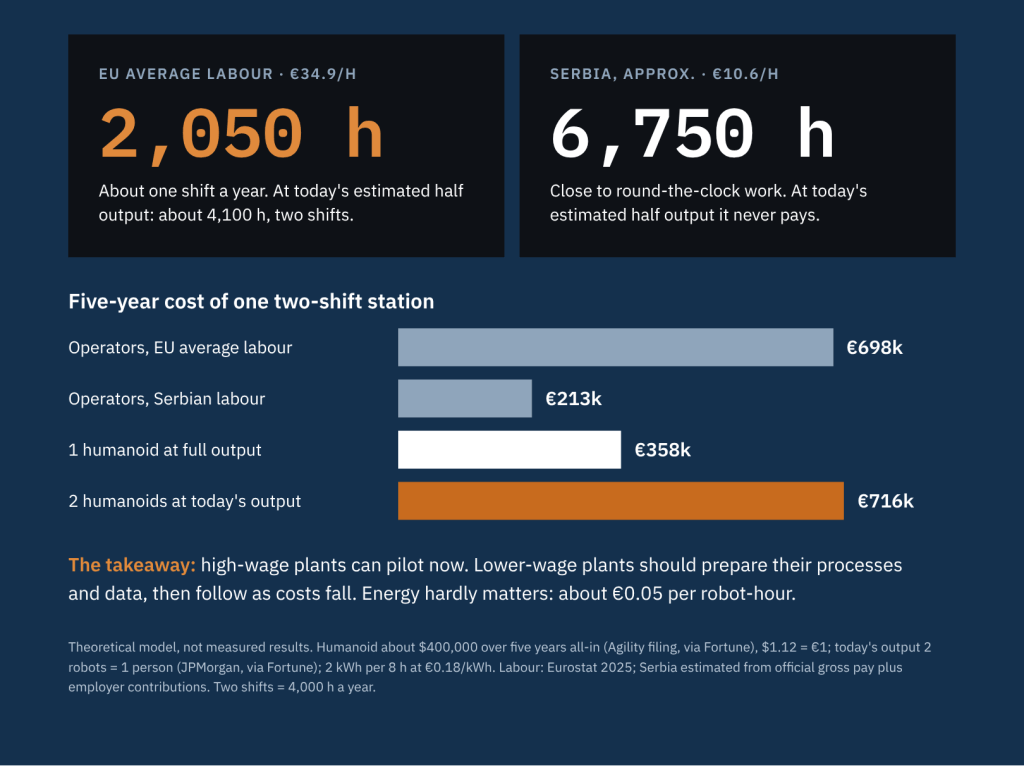
Two findings stand out. First, energy hardly matters: five years of electricity costs less than €1,000 per robot. The case rests on hours worked and output per hour.
Second, the local wage decides almost everything. Against EU-average labour, a humanoid at full human output breaks even at about 2,050 hours a year, roughly one shift. At today’s estimated half output it needs about 4,100 hours, two shifts. Against Serbian labour it needs about 6,750 hours a year at full output, close to round-the-clock work, and at today’s output it never pays.
High-wage plants pilot; lower-wage plants prepare
This is the point I most want to make to plant managers in my part of the world. The same technology calls for different moves in different places.
In Germany, the United States, Japan or Korea, with labour above €35 an hour and shifts that are hard to staff, it makes sense to pilot one task now: on two shifts or more, under a service contract with clear exit terms and published KPIs.
In Serbia, Egypt and other lower-wage manufacturing hubs, a humanoid does not pay yet. The smart move is to prepare: standardise the work, digitise material flows, measure OEE baselines and track service prices. When costs fall, and they will, the plants that did the groundwork will deploy in months instead of years.
Five questions before you sign a pilot
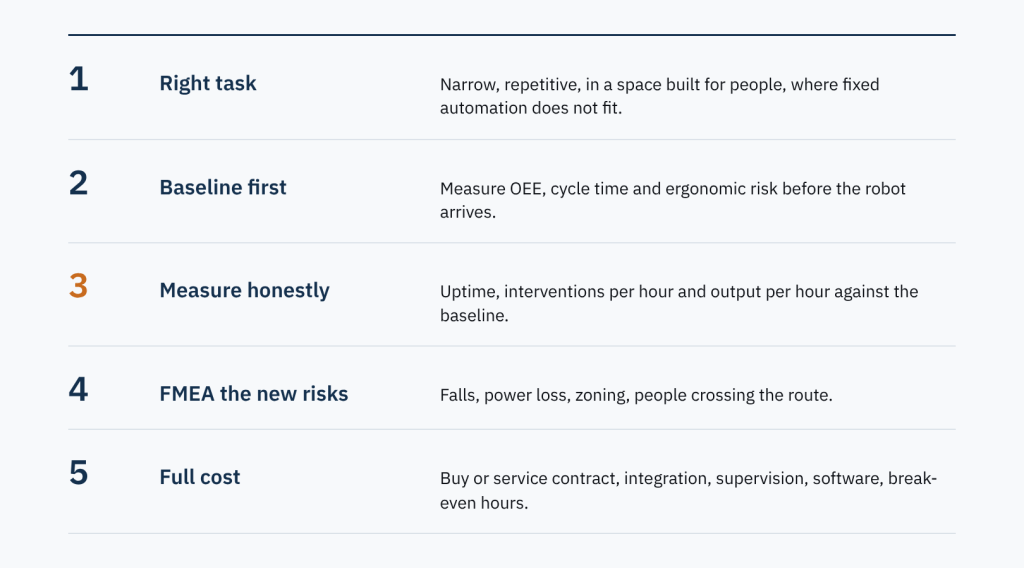
- Right task. Narrow, repetitive, in a space built for people, where fixed automation does not fit.
- Baseline first. Measure OEE, cycle time and ergonomic risk before the robot arrives.
- Measure honestly. Uptime, interventions per hour and output per hour against the baseline. This is what most announced pilots lack.
- FMEA the new risks. Falls, power loss, zoning, people crossing the route.
- Full cost. Buy or service contract, integration, supervision, software and break-even hours.
Signals I will be watching in 2027
- Deployments moving from single digits to fleets, with uptime, interventions and cost per hour made public.
- The publication of ISO 25785-1, which lets humanoids work closer to people.
- Whether Agility’s Digit 5, with a 90-minute run and a 9-minute charge, really delivers 20 or more working hours a day.
- Whether China meets its 10,000-robot target, and how many of those robots do factory work rather than demonstrations.
- Published service prices per hour or per month: the number that will decide adoption in lower-wage plants.
- Whether Hyundai, Figure, Tesla and Agility reach real volume against the Chinese makers.
The full infographic
Everything above on one page. Click the image to open it at full size.

Humanoids are already at work. For most plants the question is not whether, but when the numbers will work for them, and whether they will be ready when they do. Where does your plant stand? Tell me in the comments.
Sources: TechNode and IT Home, H1 2026 humanoid shipments (Aug 2026); International Federation of Robotics, humanoid sales count via TechRepublic (Sept 2026) and World Robotics 2026; Goldman Sachs forecast via Humanoid.guide and 24/7 Wall St. (Sept 2026); Bank of America and Smart Analytics Global via Robotics 24/7 (Oct 2026); Caixin, China’s commercial-use target (June 2026); Deloitte and The Manufacturing Institute, manufacturing workforce study (Apr 2024); TechCrunch, Toyota and Agility (Feb 2026); The Robot Report, BMW and Figure 03 (June 2026) and Schaeffler and Hexagon (Apr 2026); UKTN, Humanoid and Schaeffler (May 2026); Axios, Hyundai and Atlas (Jan 2026); ASSEMBLY, Mercedes-Benz and Apptronik (Mar 2025); UBTech (Nov 2025); Electrek, Tesla Optimus (Apr 2026); Fortune, the economics of physical AI (Oct 2026); Humanoids Daily, Digit 5 (Oct 2026); WION, robot running costs (Oct 2026); i-SCOOP on ISO 25785-1; World Economic Forum, Future of Jobs Report 2025; Eurostat, labour costs 2025 and electricity prices H1 2026; Republic Statistical Office of Serbia, average gross salary (Aug 2026).
Charts drawn for this post from the sources above. The break-even model is a theoretical estimate, not measured results.


Leave a Reply