Category: Reflections

Personal thoughts on mind, people and society.

  • Mind Your Mind — Part 2: The Mind as a System

    Mind Your Mind — Part 2: The Mind as a System

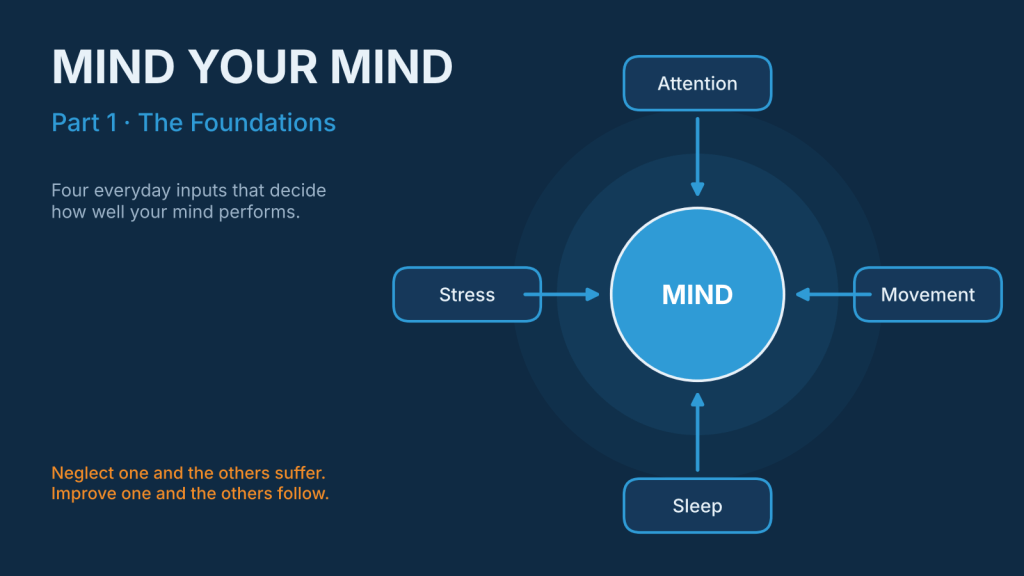
    In Part 1 we looked at four everyday inputs that decide how well your mind performs: attention, movement, sleep and stress.

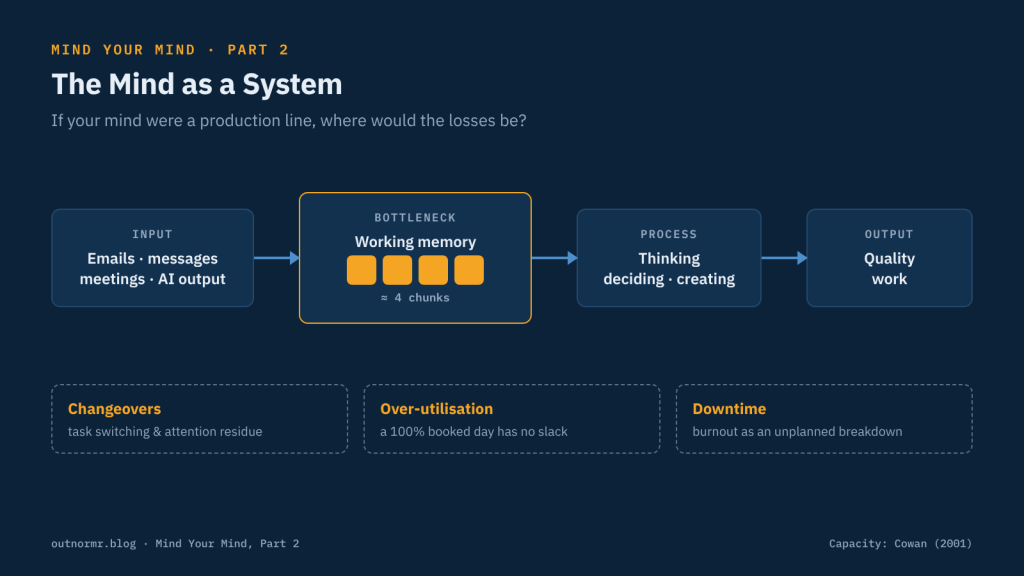
    This week I want to look at the same mind through a different lens: the one I use every day on the shop floor. If your mind were a production line, how would an operations engineer assess it? Where is the bottleneck? How much time goes into changeovers? How close to 100% is it running? And what happens when maintenance is skipped?

    The analogy isn’t perfect (people aren’t machines) but it’s surprisingly useful.

    1. Capacity: a very small buffer

    Every line has a bottleneck. In the mind, a strong candidate is working memory, the mental workspace where you hold and juggle information while you think.

    It’s smaller than most people assume. Psychologist Nelson Cowan’s review of the research suggests it holds about four chunks of information at once, not the “seven plus or minus two” many of us learned.

    In operations, the Theory of Constraints teaches a simple rule: an hour lost at the bottleneck is an hour lost for the whole system. The same applies here. Every notification, open loop and half-finished task occupies part of that tiny buffer.

    Engineer’s fix: protect the bottleneck. Write things down instead of holding them in your head, keep one task in front of you, and close loops before opening new ones.

    2. Changeovers: the hidden setup time

    On a production line, switching from one product to another costs setup time. In the mind, switching from one task to another works the same way.

    Research by David Meyer, Joshua Rubinstein and colleagues found that every switch has a time cost. It can be just a few tenths of a second, but it grows with task complexity and unfamiliarity, and it adds up when we switch back and forth all day. Meyer has estimated that heavy switching can cost up to 40% of productive time. That’s an estimate rather than a single measured figure, but the direction is clear.

    There’s a second loss. Sophie Leroy, now dean of the University of Washington Bothell’s business school, showed that when we switch, part of our attention stays behind on the previous task. She calls it attention residue: like a machine still carrying traces of the last batch.
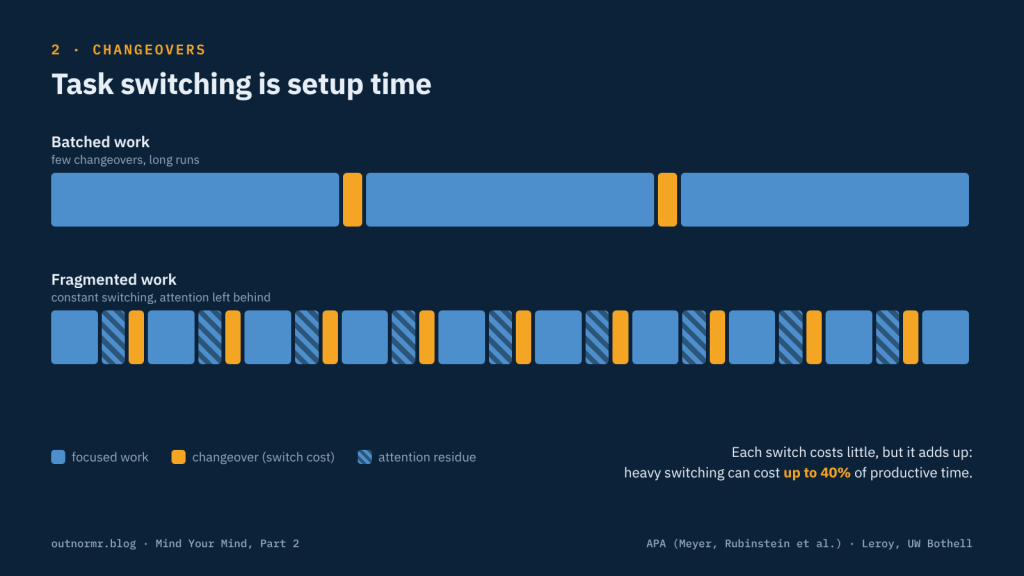
    Two timelines: batched work with few changeovers versus fragmented work with many task switches and attention residue; heavy switching can cost up to 40% of productive time

    Engineer’s fix: apply SMED to your day.

    • Batch similar tasks (all calls together, all emails together).
    • Before switching, take one minute to note where you stopped and what’s next. Leroy calls this a “ready-to-resume” plan, and her research shows it helps the brain set the unfinished task aside.

    3. Utilisation: why 100% booked means 0% flexible

    Any planner knows this from queueing theory: as a resource approaches 100% utilisation, waiting times don’t grow gradually, they explode. At 50% load a job waits about one unit of time; at 80%, about four; at 90%, about nine; at 95%, about nineteen.
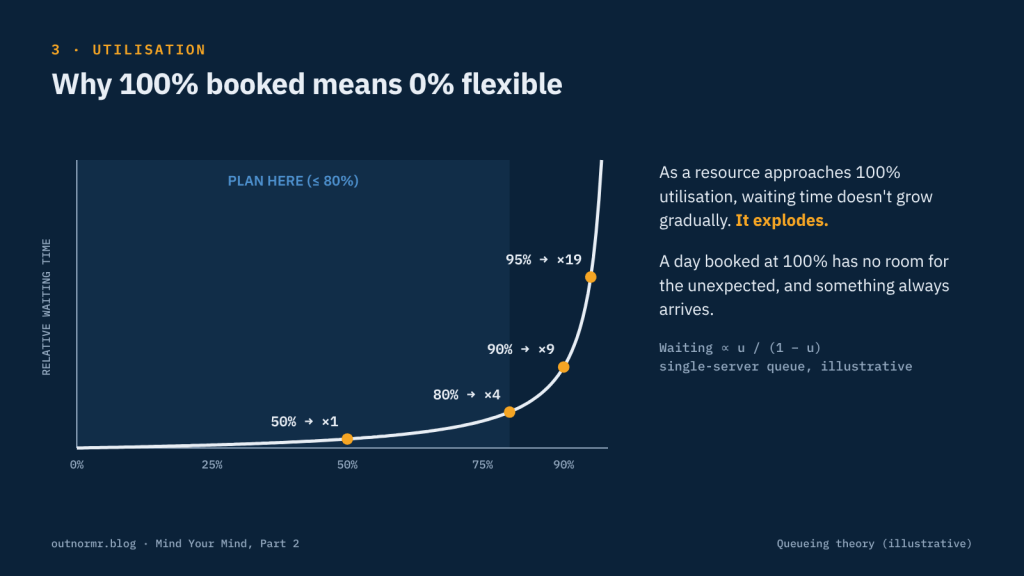
    Curve of relative waiting time against utilisation: about 1x at 50%, 4x at 80%, 9x at 90% and 19x at 95%, with the zone up to 80% marked as where to plan

    Now look at a typical knowledge worker’s day. According to Microsoft’s 2025 Work Trend Index, people using Microsoft 365 are interrupted every two minutes by a meeting, email or notification, around 275 times a day, with an average of 117 emails and 153 Teams messages daily. Nearly half of employees (48%) say their work feels chaotic and fragmented.
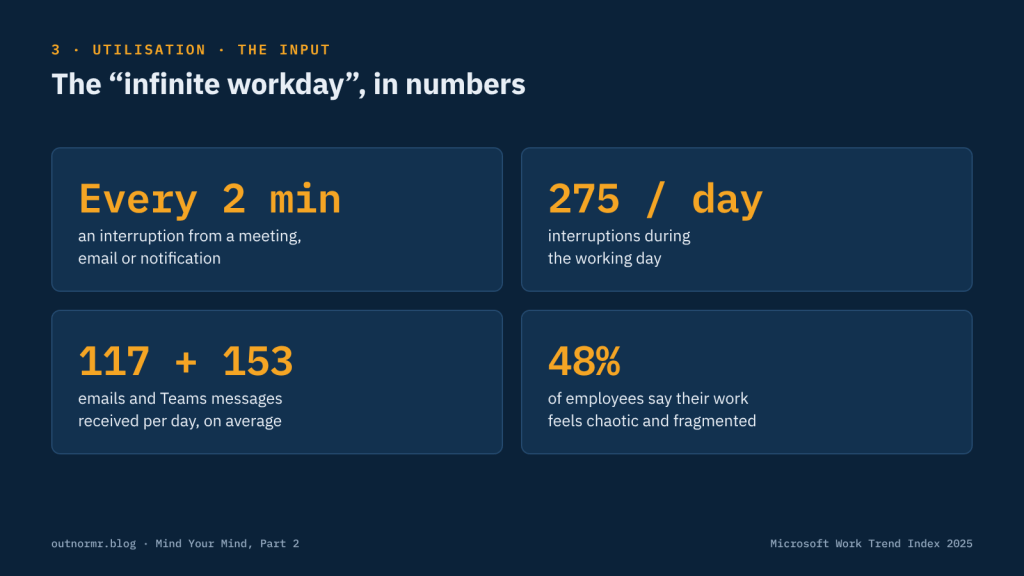
    Stat cards: interrupted every 2 minutes, 275 interruptions a day, 117 emails and 153 Teams messages daily, 48% say work feels chaotic (Microsoft Work Trend Index 2025)

    That’s a line running at full utilisation with a constant stream of rush orders. Nothing flows.

    Engineer’s fix: plan your day to roughly 80%, not 100%. Keep buffer time for the unexpected, and turn interruptions into scheduled batches instead of a continuous feed.

    4. Downtime: burnout is a breakdown, not a weakness

    Every maintenance engineer knows the difference between planned and unplanned downtime. One is cheap and scheduled. The other is expensive and arrives at the worst moment.

    The World Health Organization describes burnout in ICD-11 as an occupational phenomenon, not a medical condition, resulting from chronic workplace stress that hasn’t been successfully managed. It has three dimensions: exhaustion, increasing mental distance or cynicism toward one’s job, and reduced professional efficacy.

    In plant terms: the machine slows down, starts producing defects, and eventually stops.

    Engineer’s fix: Total Productive Maintenance for people. Sleep, movement and recovery (from Part 1) are your planned maintenance. Skip them long enough and the system schedules its own downtime.

    5. The new input: AI floods the line

    AI can draft, summarise and generate faster than any human can read. That’s powerful, but in system terms it can also mean more input arriving at the same small buffer.

    Microsoft’s own report warns of the risk of using AI to accelerate a broken system. The opportunity is the opposite: use AI as an incoming quality filter that summarises, prioritises and removes noise before it reaches you, not as another source of noise.

    The takeaway: OEE for the mind

    In manufacturing we measure Overall Equipment Effectiveness as Availability × Performance × Quality. As a thinking tool, it maps neatly onto the mind:

    • Availability: are you rested and present, or heading for downtime?
    • Performance: how much capacity is lost to changeovers and interruptions?
    • Quality: how many errors and rework come from a divided mind?
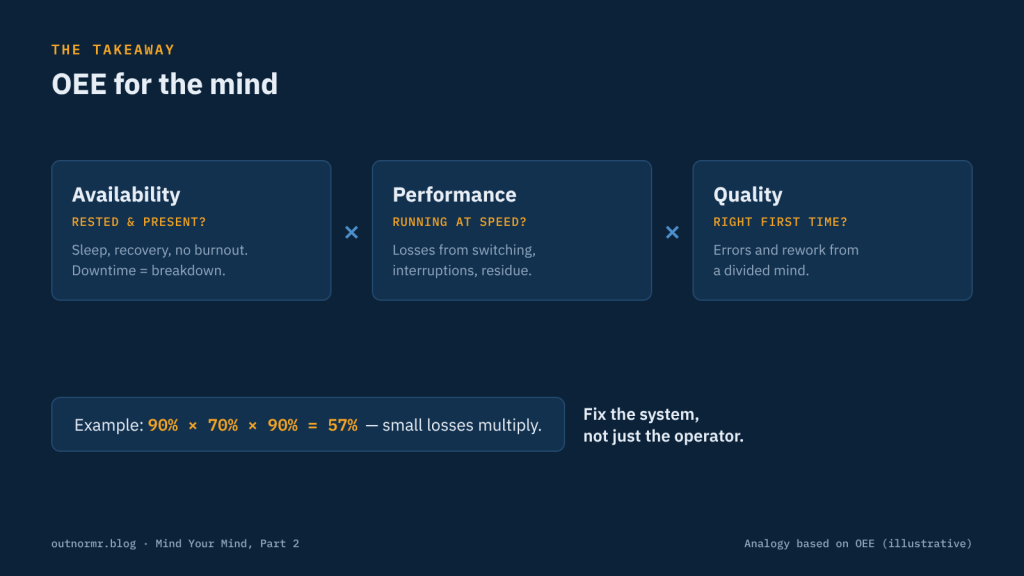
    OEE for the mind: Availability times Performance times Quality; example 90% x 70% x 90% equals 57%, showing small losses multiply

    Just like on the line, a small loss in each one multiplies. Fix the system, not just the operator.

    Next week, Part 3: Leaders & Engineers. What this means for teams, and what managers can change so their people’s minds aren’t running at 100% with no maintenance window.


    This article is for general information and is not medical advice.

    Sources

  • Mind Your Mind — Part 1: The Foundations

    Mind Your Mind — Part 1: The Foundations

    In 2023 I wrote a short note on this blog called “Mind your minds”. The message was simple: the brain is the most powerful tool we own, and we treat it worse than any machine on a shop floor.

    Three years later, the message hasn’t changed, but the pressure has. More screens, more notifications, and now AI tools that can generate more information in a minute than we can read in a day. So I’m rewriting that article, this time with the research behind it, and turning it into a three-part series.

    Part 1 covers the foundations: four everyday inputs that decide how well your mind performs — attention, movement, sleep and stress.

    1. Attention: from 150 seconds to 47

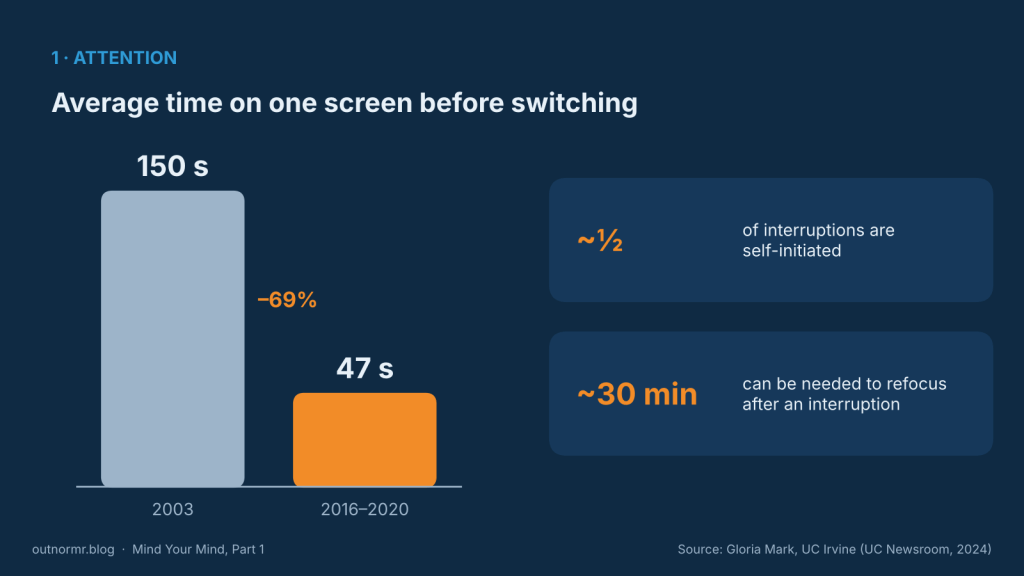
    Gloria Mark, professor emerita of informatics at UC Irvine, has been measuring how long people stay on one screen before switching for more than 20 years. In her first study, conducted in 2003, the average was about two and a half minutes. Across studies from 2016 to 2020, it had fallen to 47 seconds.

    Bar chart: average attention on one screen fell from 150 seconds in 2003 to 47 seconds in 2016–2020

    Two findings from her work matter most:

    • About half of our interruptions are self-inflicted. Nobody called us; we just reached for email or a quick search.
    • Recovery is expensive. Getting back into a task after an interruption can take close to half an hour.

    Mark doesn’t recommend going cold turkey on phones or social media. Her advice is to be intentional: keep your goal visible (literally, on a sticky note in your field of view), notice the traps that pull you into scrolling, and use light, easy activities to give your mind a rest after demanding work. She borrows Maya Angelou’s idea of a “big mind” for deep work and a “little mind” for simple tasks that let the big one recover.

    Try this week:

    • Block one 60–90 minute window a day for a single important task, with notifications off.
    • Check email and messages in planned batches instead of constantly.
    • Write the day’s main goal on paper and keep it in sight.

    2. Movement: exercise doesn’t cancel out sitting

    Most of us know exercise is good for the brain. Fewer know that long, unbroken sitting has its own effect, even for people who exercise.

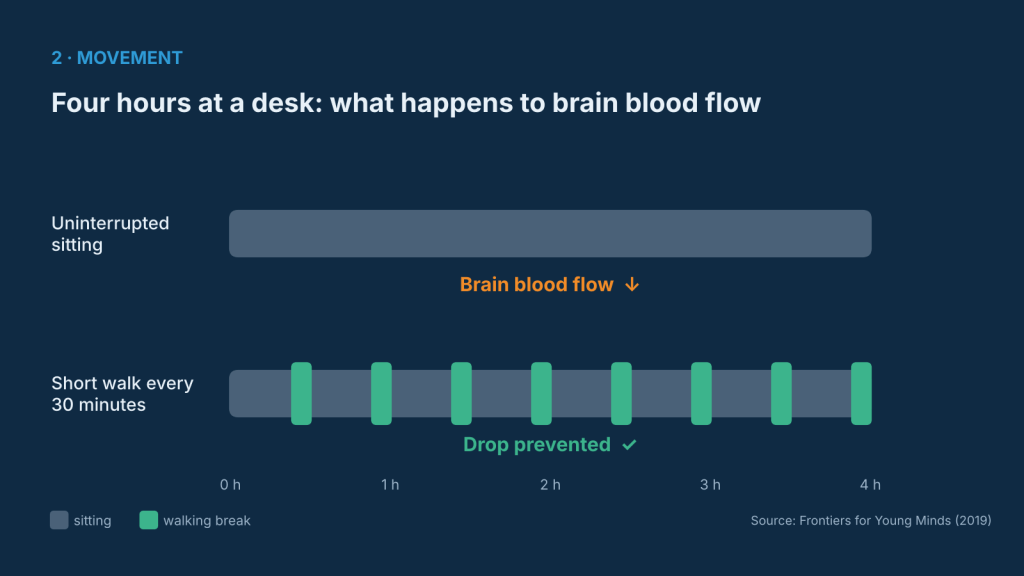
    In one study, office workers sat at a desk for four hours. Blood flow to the brain dropped. When they took a short walking break every 30 minutes, the drop was prevented. Reduced blood flow to the brain, even over short periods, can lower cognition — the mental processes we use to think, understand and learn.

    Timeline: four hours of uninterrupted sitting lowers brain blood flow; a short walk every 30 minutes prevents the drop

    A study from Vanderbilt University and partners, published in Alzheimer’s & Dementia, went further: in people aged 50 and over, the link between sedentary time and brain health remained even among those who were physically active. In other words, a gym session in the morning doesn’t fully undo eight hours in a chair.

    Try this week:

    • Stand up and walk for 2–3 minutes every 30 minutes.
    • Take phone calls standing or walking.
    • Turn one regular one-to-one meeting into a walking meeting.

    3. Sleep: the brain’s night shift

    Sleep is not downtime. It’s when the brain does its maintenance.

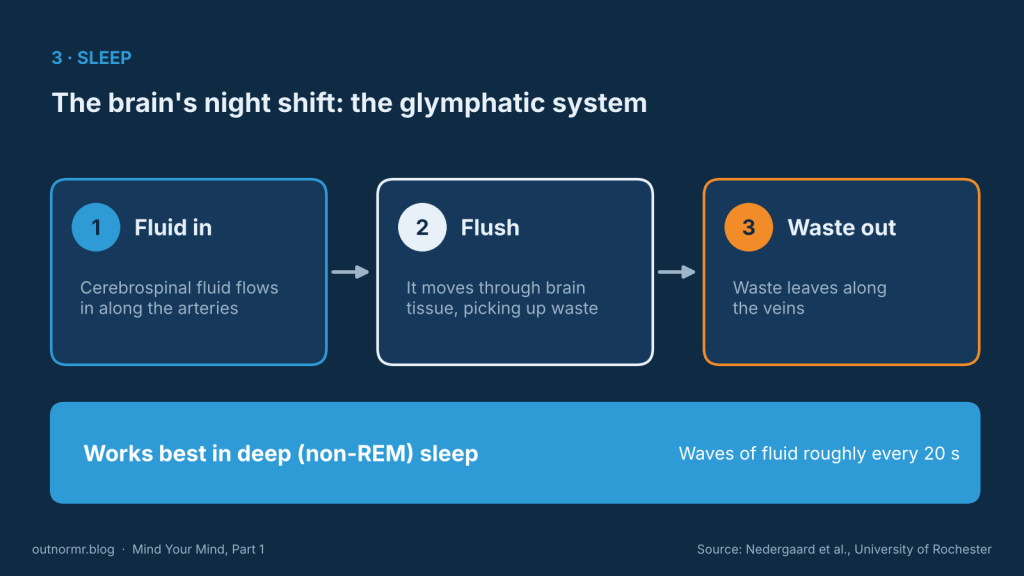
    In 2012, Maiken Nedergaard and her team at the University of Rochester described the glymphatic system, a network that pumps cerebrospinal fluid through brain tissue to wash away waste. Later work showed this system is mainly active during sleep, and that deep, non-REM sleep is when it works best. Studies in humans have since observed large waves of fluid moving through the brain roughly every 20 seconds during deep sleep.

    Three-step diagram of the glymphatic system: fluid in along arteries, flush through brain tissue, waste out along veins; works best in deep sleep

    Why it matters: the build-up of proteins such as beta-amyloid and tau is associated with Alzheimer’s disease, and poor sleep has been linked to a range of neurodegenerative conditions. Sleep quality is not a lifestyle detail; it’s brain maintenance.

    Try this week:

    • Aim for at least 7 hours, the general recommendation for adults.
    • Keep the same wake-up time, including weekends.
    • Put screens away 30–60 minutes before bed, and stop caffeine by early afternoon.

    4. Stress: a personal issue with a global price tag

    Stress and anxiety are often treated as private struggles. The numbers say otherwise.

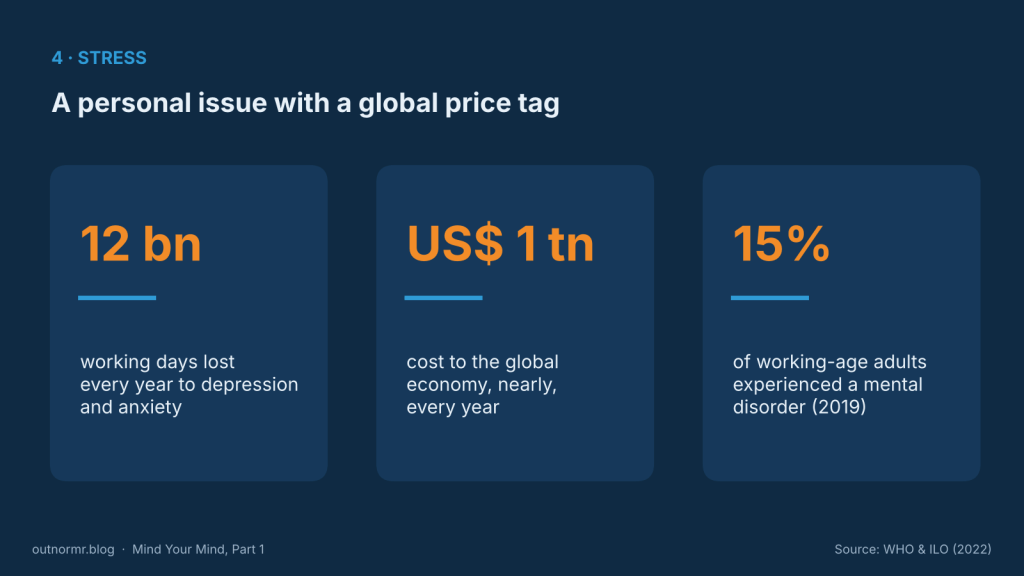
    According to the World Health Organization and the International Labour Organization, an estimated 12 billion working days are lost every year to depression and anxiety, costing the global economy nearly US$1 trillion. WHO’s 2022 World Mental Health Report found that 15% of working-age adults experienced a mental disorder in 2019.

    Stat cards: 12 billion working days lost yearly to depression and anxiety, nearly US$1 trillion cost, 15% of working-age adults affected

    That makes mental health an operational issue as much as a personal one, for individuals, teams and companies. (Part 3 of this series looks at what leaders can do about it.)

    Try this week:

    • Schedule recovery like you schedule work: a walk, time outdoors, a hobby, time with people you like.
    • Use simple techniques such as slow breathing between demanding tasks.
    • If stress or low mood is persistent, talk to a professional. That’s maintenance, not weakness.

    The takeaway

    Attention, movement, sleep and stress are not four separate wellness tips. They are inputs to the same system. Neglect one and the others suffer; improve one and the others usually follow.

    So mind your mind. Protect your focus, break up your sitting, guard your sleep and plan your recovery.

    Continue with Part 2: The Mind as a System. We look at the mind the way an operations engineer looks at a production line: capacity, utilisation, downtime and what happens when AI floods the input.


    This article is for general information and is not medical advice.

    Sources