Tag: Future of work

  • Humanoids at work: global trends in industry and manufacturing

    Humanoids at work: global trends in industry and manufacturing

    Humanoid robots are no longer a question of whether. They are being built by the tens of thousands, bought by carmakers and written into national industrial plans. The open questions are different now: how fast, where, for which jobs, and when they pay for themselves on a real shop floor.

    In my last post, From the Stopwatch to the Agent, humanoids appeared near the end, as the newest chapter in 140 years of engineering work. This post zooms in on that chapter. It is a trend brief from a manufacturing engineer’s point of view: what the 2026 numbers say, who is actually deploying humanoids in factories, and what a plant should do about it.

    2026 in five numbers
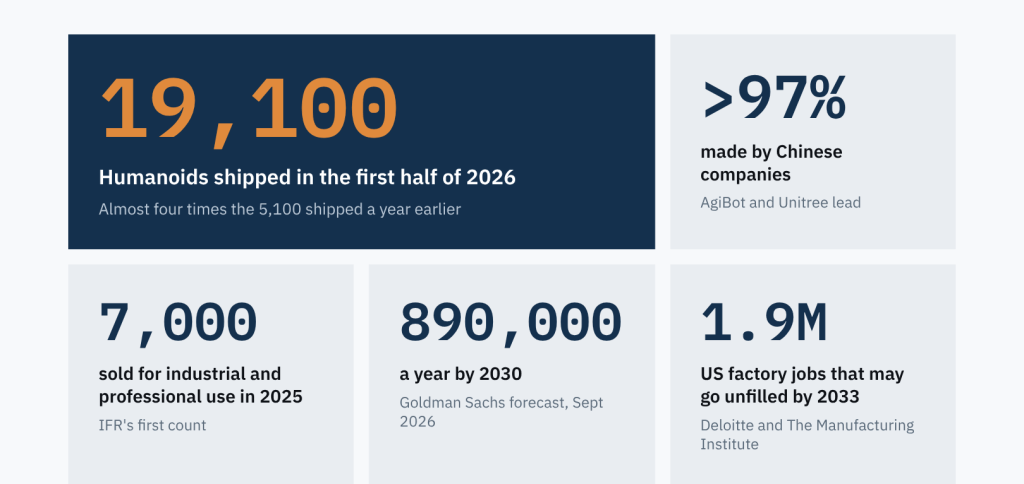
    Five figures: 19,100 humanoids shipped in the first half of 2026; over 97% made by Chinese companies; 7,000 sold for industrial and professional use in 2025; 890,000 a year forecast by 2030; 1.9 million US factory jobs that may go unfilled by 2033.
    Volume is real; factory use is still early.

    Put together, the numbers tell a simple story. Volume is real and growing fast. Factory use is still early. And the pull from a shrinking industrial workforce is strong enough that neither investors nor carmakers want to wait.

    Shipments almost quadrupled in a year

    About 19,100 humanoids were shipped worldwide in the first half of 2026, up from roughly 5,100 a year earlier. That is almost as many in six months as in all of 2025, when about 20,000 were built. Analysts expect 60,000 to 90,000 for the full year: three to four and a half times 2025’s volume.
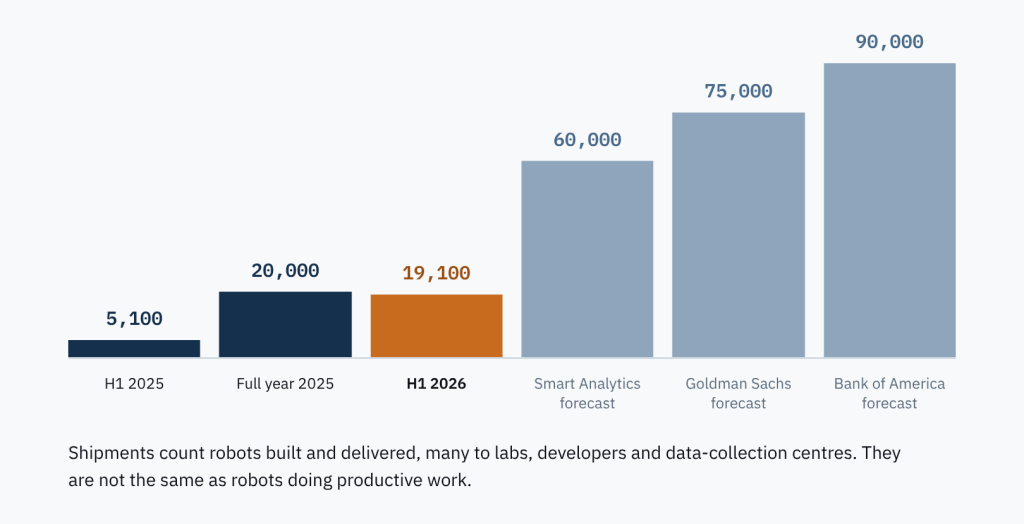
    Bar chart of humanoid shipments: 5,100 in H1 2025, 20,000 in full-year 2025, 19,100 in H1 2026, and 2026 forecasts of 60,000 (Smart Analytics), 75,000 (Goldman Sachs) and 90,000 (Bank of America).
    Humanoids shipped worldwide. Grey bars are forecasts for 2026.

    A caution before the excitement: shipments count robots built and delivered. Many go to universities, developers and the data-collection centres where robots are trained by teleoperation. They are not the same as robots doing productive work in a plant.

    China builds almost all of them

    More than 97% of the humanoids shipped in the first half of 2026 came from Chinese companies. Two of them, AgiBot and Unitree, shipped about three in four.
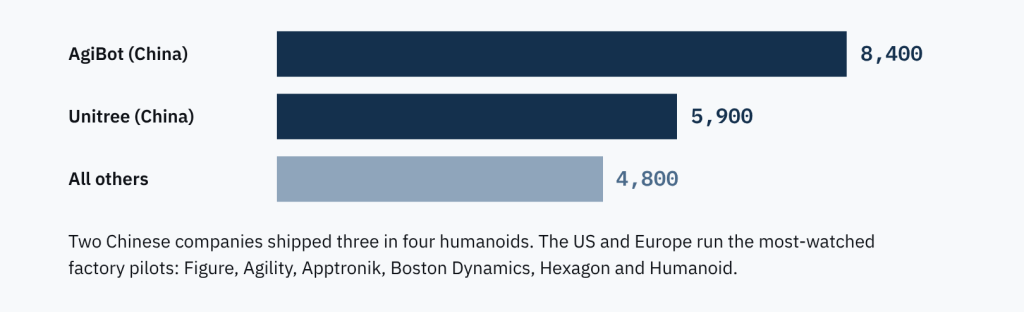
    Bar chart of humanoid shipments by maker in the first half of 2026: AgiBot 8,400, Unitree 5,900, all others 4,800.
    Shipments by maker, first half of 2026.

    Policy is part of the reason. In June 2026 China’s industry ministry and its state-asset regulator told local governments and state-owned companies to put more than 10,000 humanoids into commercial use by the end of the year, across manufacturing, logistics, retail, healthcare and emergency response. Chinese embodied-AI start-ups raised $2.9 billion in the first quarter alone.

    The United States and Europe ship far fewer units but run the most-watched factory pilots, with Figure, Agility, Apptronik, Boston Dynamics, Hexagon and the British start-up Humanoid. The money is following there too. Figure is valued at $39 billion, and factories for tens of thousands of robots a year are going up: Hyundai plans capacity for 30,000 Atlas robots a year by 2028, and Figure’s BotQ plant is sized for 12,000. Capacity is not demand, though. Most buyers are still piloting.

    Still about 1% of factory automation

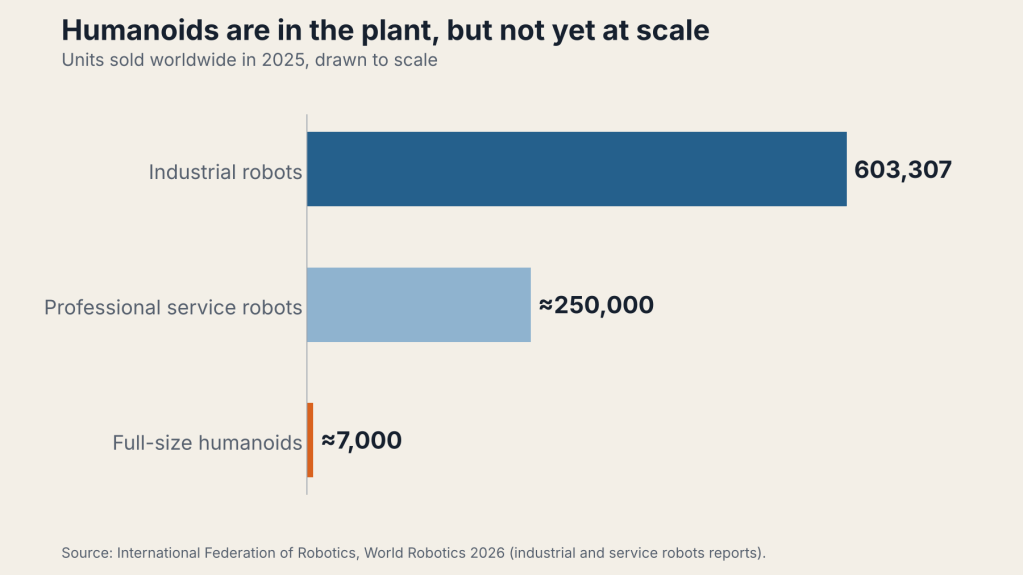
    Against the wider robot market, humanoids are still a rounding error. The International Federation of Robotics counted about 7,000 humanoids sold for industrial and professional use in 2025, its first such count. Factories installed 603,307 conventional industrial robots in the same year.
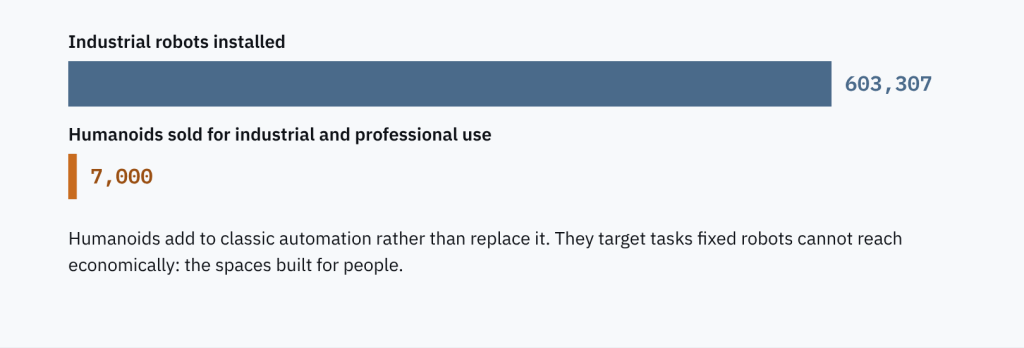
    Bar chart drawn to scale: 603,307 industrial robots installed in 2025 against 7,000 humanoids sold for industrial and professional use.
    Humanoids against industrial robots, 2025, drawn to scale.

    That gap matters for how to think about humanoids. They do not replace classic automation. A fixed robot or a conveyor will stay faster and cheaper for any stable, high-volume task. Humanoids target the jobs fixed automation cannot reach economically: spaces built for people, with carts, shelves and stations laid out at human height.

    Who is putting them to work

    Carmakers and their suppliers are the main industrial testers. Most programmes sit in the middle of the ladder: pilots and plans, not paid fleets.
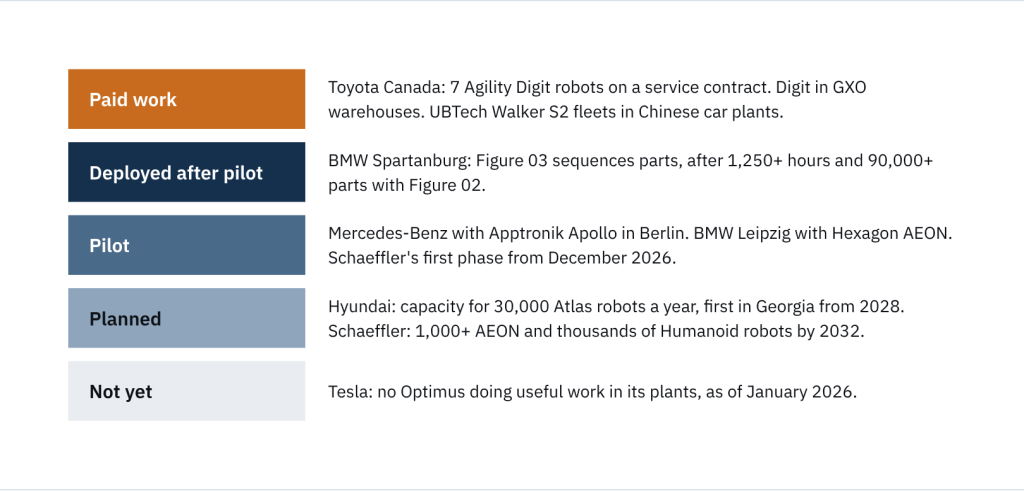
    Adoption ladder in five rungs: paid work (Toyota Canada, GXO, UBTech in Chinese car plants); deployed after pilot (BMW Spartanburg with Figure 03); pilot (Mercedes-Benz, BMW Leipzig, Schaeffler); planned (Hyundai from 2028, Schaeffler to 2032); not yet (Tesla).
    The adoption ladder in 2026.
    • Toyota and Agility. In February 2026 Toyota’s RAV4 plant in Canada signed a robots-as-a-service contract for seven Digit robots, after a year-long pilot. They unload totes of parts between two automated lines. Toyota pays for the work, not the machines.
    • BMW and Figure. Figure 02 worked in BMW’s Spartanburg body shop for 11 months, logging more than 1,250 hours, loading over 90,000 sheet-metal parts and supporting the production of more than 30,000 X3s. In June 2026 BMW deployed the new Figure 03 for parts sequencing. In Leipzig it is testing Hexagon’s wheeled AEON.
    • Hyundai and Atlas. Boston Dynamics launched the production version of Atlas in January 2026. Hyundai plans capacity for 30,000 a year and will start using them in Georgia from 2028, parts sequencing first, with component assembly targeted by 2030.
    • Schaeffler. The German supplier has committed to at least 1,000 AEON robots by 2032, and signed a service deal for thousands of robots from Humanoid, starting in two German plants in December 2026.
    • UBTech in China. Its Walker S2 has more than ¥800 million in orders from BYD, Geely, FAW-Volkswagen, Foxconn and others, delivered in phases.
    • Mercedes-Benz. An investor in Apptronik, it is piloting the Apollo robot for intralogistics and first quality checks in Berlin.
    • Tesla. In January 2026 the company said no Optimus robot was yet doing useful work in its plants.

    What they do on the floor today

    Look past the announcements and the tasks are strikingly similar:

    • Tote and box handling: Toyota, GXO, Schaeffler.
    • Parts sequencing: BMW with Figure 03; Hyundai’s first Atlas task.
    • Machine loading: sheet metal into welding fixtures at BMW; load, unload and inspect at Schaeffler.

    The pattern is one narrow, repetitive material-handling task, placed between existing automation, with people overseeing. Fine assembly, maintenance with tools and fast re-tasking from one job to another are still demonstrations, not deployed work. That is not a weakness to hide. It is the right place to start.

    What slows adoption

    • Cost. One illustrative estimate puts a Digit at about $200,000, or around $400,000 over five years, and Agility’s CTO says integration can cost more than the robot itself. The makers are not profitable yet: Agility reported $1.8 million of 2025 sales against a $140 million operating loss.
    • Safety. A robot that balances can also fall. ISO 25785-1, the first standard for actively balancing robots, is still a draft, expected in late 2026 or 2027. Until then, plants work from ISO 10218 with a fall-zone analysis.
    • Missing reliability data. No maker publishes uptime, interventions per hour or mean time between failures. Without them, no plant can build an honest business case.
    • People. Employers expect 39% of core skills to change by 2030. As my last post argued, the human half of a change usually decides whether the technical half pays.

    When does a humanoid pay?

    To get past the hype, I built a simple theoretical model for one workstation. It compares the cost of a humanoid per hour of work with the cost of a person, and asks how many hours a year the robot must work to break even.

    The assumptions: a humanoid costs about $400,000 over five years, all-in, based on figures in Agility’s filing reported by Fortune; that is about €71,000 a year at $1.12 to the euro. It uses 1 to 3 kWh per eight-hour shift, about €0.05 an hour at EU business electricity prices. Today’s robots are estimated to do about half the work of a person per hour, while vendors aim for parity. Labour costs €34.90 an hour on the EU average (Eurostat, 2025) and roughly €10.60 in Serbia, which I estimated from official gross pay plus employer contributions.
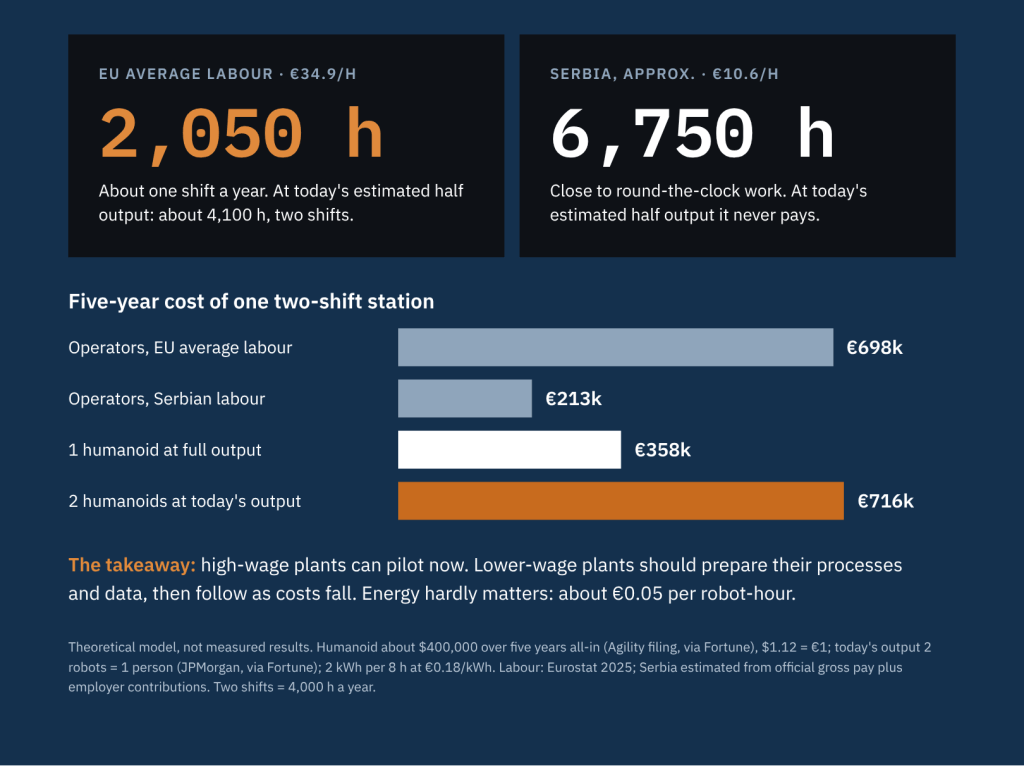
    Theoretical model: a humanoid breaks even at 2,050 hours a year against EU average labour and 6,750 hours against Serbian labour. Five-year cost of a two-shift station: EU operators €698k, Serbian operators €213k, one humanoid at full output €358k, two humanoids at today's output €716k.
    A theoretical model, not measured results. Assumptions in the text above.

    Two findings stand out. First, energy hardly matters: five years of electricity costs less than €1,000 per robot. The case rests on hours worked and output per hour.

    Second, the local wage decides almost everything. Against EU-average labour, a humanoid at full human output breaks even at about 2,050 hours a year, roughly one shift. At today’s estimated half output it needs about 4,100 hours, two shifts. Against Serbian labour it needs about 6,750 hours a year at full output, close to round-the-clock work, and at today’s output it never pays.

    High-wage plants pilot; lower-wage plants prepare

    This is the point I most want to make to plant managers in my part of the world. The same technology calls for different moves in different places.

    In Germany, the United States, Japan or Korea, with labour above €35 an hour and shifts that are hard to staff, it makes sense to pilot one task now: on two shifts or more, under a service contract with clear exit terms and published KPIs.

    In Serbia, Egypt and other lower-wage manufacturing hubs, a humanoid does not pay yet. The smart move is to prepare: standardise the work, digitise material flows, measure OEE baselines and track service prices. When costs fall, and they will, the plants that did the groundwork will deploy in months instead of years.

    Five questions before you sign a pilot
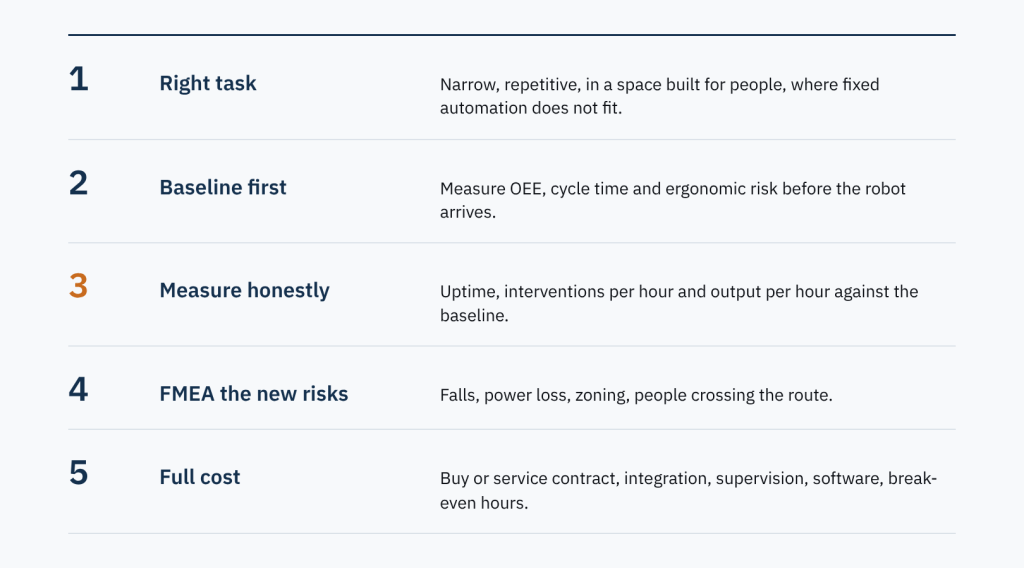
    Five questions before a humanoid pilot: right task, baseline first, measure honestly, FMEA the new risks, full cost.
    1. Right task. Narrow, repetitive, in a space built for people, where fixed automation does not fit.
    2. Baseline first. Measure OEE, cycle time and ergonomic risk before the robot arrives.
    3. Measure honestly. Uptime, interventions per hour and output per hour against the baseline. This is what most announced pilots lack.
    4. FMEA the new risks. Falls, power loss, zoning, people crossing the route.
    5. Full cost. Buy or service contract, integration, supervision, software and break-even hours.

    Signals I will be watching in 2027

    • Deployments moving from single digits to fleets, with uptime, interventions and cost per hour made public.
    • The publication of ISO 25785-1, which lets humanoids work closer to people.
    • Whether Agility’s Digit 5, with a 90-minute run and a 9-minute charge, really delivers 20 or more working hours a day.
    • Whether China meets its 10,000-robot target, and how many of those robots do factory work rather than demonstrations.
    • Published service prices per hour or per month: the number that will decide adoption in lower-wage plants.
    • Whether Hyundai, Figure, Tesla and Agility reach real volume against the Chinese makers.

    The full infographic

    Everything above on one page. Click the image to open it at full size.

    Full infographic, Humanoids at work: global trends in industry and manufacturing, 2026. Covers shipments, makers, adoption in car plants, tasks done today, the break-even model and five questions before a pilot.
    Humanoids at work, the full infographic.

    Humanoids are already at work. For most plants the question is not whether, but when the numbers will work for them, and whether they will be ready when they do. Where does your plant stand? Tell me in the comments.


    Sources: TechNode and IT Home, H1 2026 humanoid shipments (Aug 2026); International Federation of Robotics, humanoid sales count via TechRepublic (Sept 2026) and World Robotics 2026; Goldman Sachs forecast via Humanoid.guide and 24/7 Wall St. (Sept 2026); Bank of America and Smart Analytics Global via Robotics 24/7 (Oct 2026); Caixin, China’s commercial-use target (June 2026); Deloitte and The Manufacturing Institute, manufacturing workforce study (Apr 2024); TechCrunch, Toyota and Agility (Feb 2026); The Robot Report, BMW and Figure 03 (June 2026) and Schaeffler and Hexagon (Apr 2026); UKTN, Humanoid and Schaeffler (May 2026); Axios, Hyundai and Atlas (Jan 2026); ASSEMBLY, Mercedes-Benz and Apptronik (Mar 2025); UBTech (Nov 2025); Electrek, Tesla Optimus (Apr 2026); Fortune, the economics of physical AI (Oct 2026); Humanoids Daily, Digit 5 (Oct 2026); WION, robot running costs (Oct 2026); i-SCOOP on ISO 25785-1; World Economic Forum, Future of Jobs Report 2025; Eurostat, labour costs 2025 and electricity prices H1 2026; Republic Statistical Office of Serbia, average gross salary (Aug 2026).

    Charts drawn for this post from the sources above. The break-even model is a theoretical estimate, not measured results.
  • From the Stopwatch to the Agent: 140 years of engineering work, and of getting people to accept it

    From the Stopwatch to the Agent: 140 years of engineering work, and of getting people to accept it

    In December 2013 I put together a short deck called Scientific Management & Change Management. Twelve years later I went back to it. Some dates were wrong, key figures were missing, and the link the title promised, between the stopwatch and the people standing next to it, was never drawn.

    This is the rebuilt version, checked against the original sources and carried forward to the AI agents and humanoid robots now arriving in factories. The argument fits in one sentence: every leap in how work is engineered has set off a crisis in how people accept it. Change management is not a soft add-on to industrial engineering. It grew out of industrial engineering’s first failures.

    1881–1911: the stopwatch

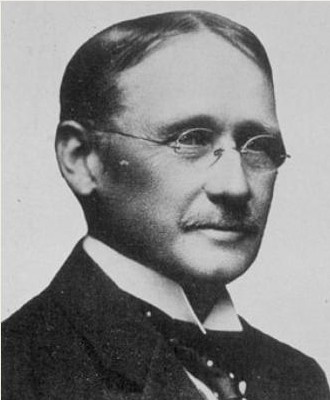
    Black-and-white portrait of Frederick Winslow Taylor in a suit and pince-nez.
    Frederick W. Taylor (1856–1915).

    In 1881, at the Midvale Steel Company in Philadelphia, Frederick W. Taylor began timing work with a stopwatch. He published Shop Management in 1903 and The Principles of Scientific Management in 1911. “Taylorism” and “scientific management” are two names for the same system, not two stages of it.

    The principal object of management should be to secure the maximum prosperity for the employer, coupled with the maximum prosperity for each employé.

    F. W. Taylor, The Principles of Scientific Management, 1911

    His four principles are usually quoted in a softened form. In plain terms they were:

    1. Science. Develop a science for each element of the work, replacing rule of thumb.
    2. Selection. Select workers scientifically, then train and develop them.
    3. Cooperation. Cooperate with workers so the work follows the science.
    4. Division. Management takes over the planning; workers execute. This is the principle that caused the trouble.

    Taylor was not alone. Frank and Lillian Gilbreth broke work into basic motions, and Lillian brought psychology into management. Henry Gantt made schedules visible with the chart that still carries his name. Henri Fayol defined management itself in 1916: plan, organise, command, coordinate, control. And in 1908 Hugo Diemer started the first industrial engineering degree, at Penn State.

    1913: flow at mass scale

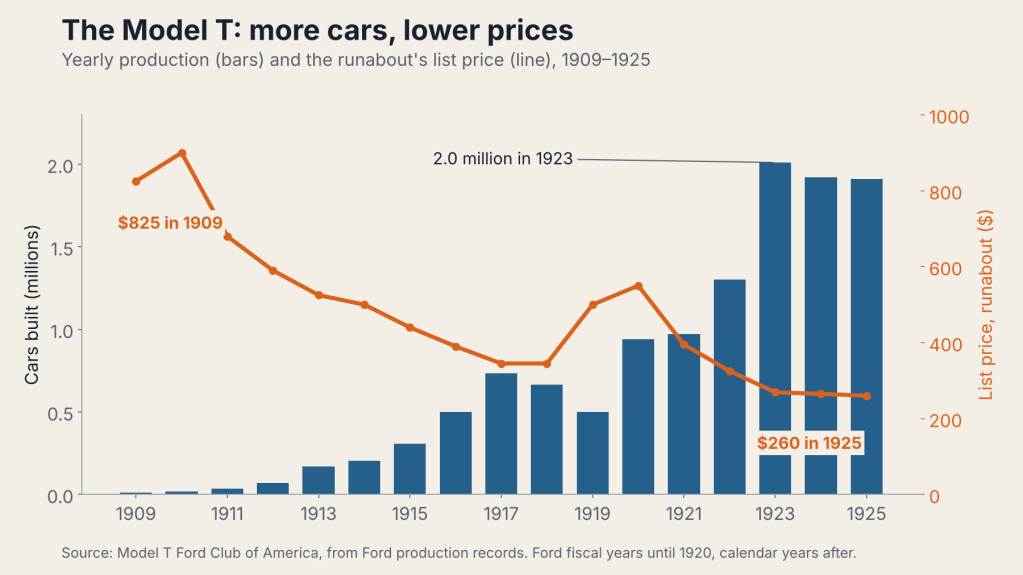
    At Highland Park in 1913, Henry Ford added the moving assembly line. Chassis assembly time fell from about twelve and a half hours to 93 minutes. The results show up in the numbers: Model T production rose from about 10,700 cars in 1909 to 2 million in 1923, while the price of the runabout fell from $825 to $260.

    Chart: Model T yearly production rises from about 10,000 cars in 1909 to 2 million in 1923, while the runabout's list price falls from $825 to $260 by 1925.
    More cars, lower prices: the Model T, 1909–1925.

    Ford’s contribution was flow and standardisation. Production cells, which my old deck wrongly filed under Ford, came later, from group technology and Toyota.

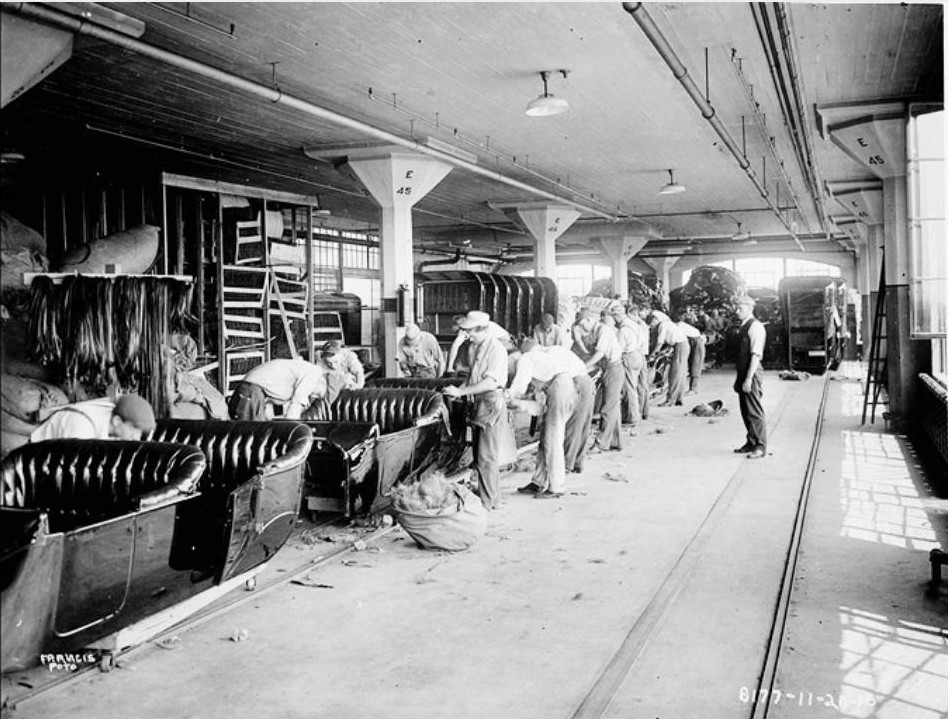
    Black-and-white photo of workers fitting upholstery into car bodies along a line at Ford's Highland Park plant, 1914.
    The body upholstery line at Highland Park, 1914. Photo: Ford Motor Company.

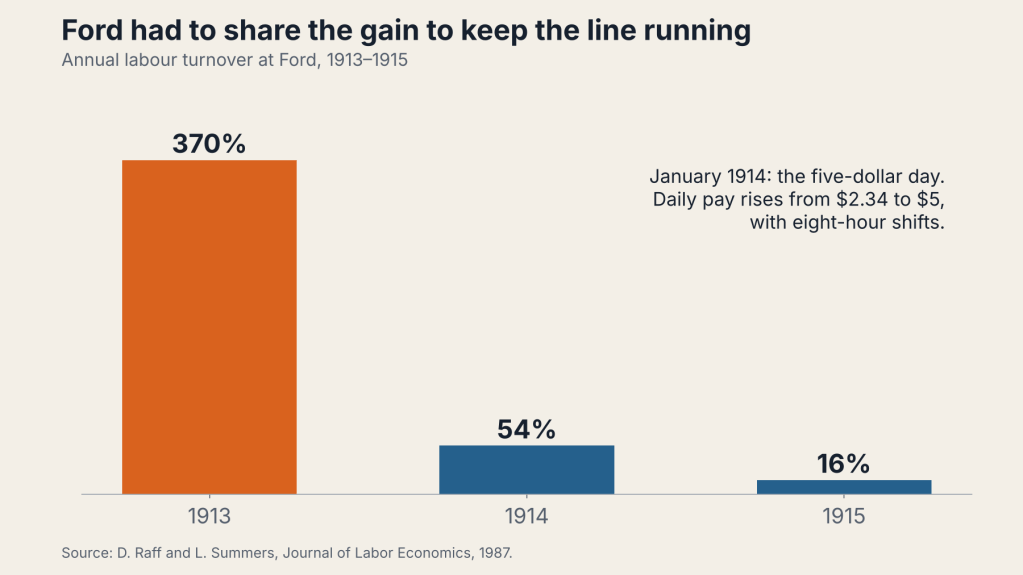
    The line had a cost that rarely makes the textbooks. In 1913 Ford’s labour turnover was 370%: the company hired around 50,000 people to keep about 13,600 jobs filled. In January 1914 Ford more than doubled daily pay, from $2.34 to the famous five dollars, and cut shifts to eight hours. Turnover fell to 54% in 1914 and 16% in 1915.

    Chart: Ford's annual labour turnover falls from 370% in 1913 to 54% in 1914 and 16% in 1915 after the five-dollar day.
    The gain from the new method had to be shared before the method could hold.

    1911–1932: the backlash

    Scientific management raised output and lost the workforce. In August 1911, molders at the Watertown Arsenal walked out over the stopwatch. In January 1912 Taylor spent four days defending his system before a special committee of the US House of Representatives. From 1915 Congress barred stopwatch time study in government arsenals, a ban renewed until 1949. Then, from 1924 to 1932, the Hawthorne studies at Western Electric suggested that attention and group norms move output as much as lighting and pay do.

    Taylor’s own answer, given to that committee, is the most important line in this story:

    Without this complete mental revolution on both sides scientific management does not exist.

    F. W. Taylor, testimony to the US House Special Committee, January 1912

    Change management was inside the method from the start. It simply took decades to be treated as a discipline of its own.

    The human side becomes a discipline

    • 1947, Kurt Lewin: unfreeze, change, refreeze.
    • 1960, Douglas McGregor: Theory X and Theory Y, two opposite assumptions about why people work.
    • 1969, Elisabeth Kübler-Ross: the stages of grief, later adapted by managers into the change curve.
    • 1995, John Kotter: eight steps for leading change.
    • 2006, Jeff Hiatt (Prosci): ADKAR, which treats change one person at a time.
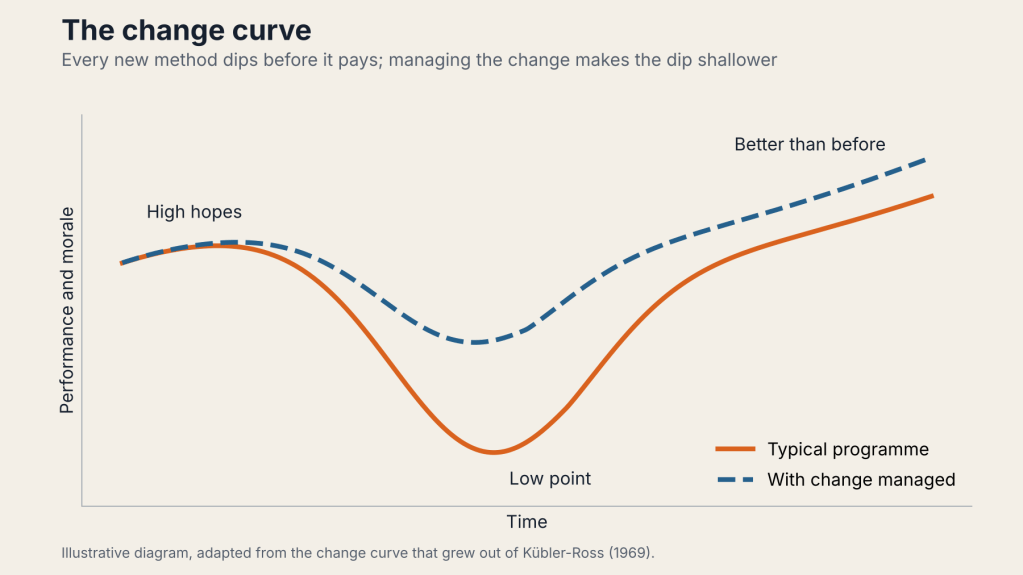
    Diagram of the change curve: performance starts with high hopes, falls to a low point, then climbs above the starting level; a dashed line shows a shallower dip when the change is managed.
    Every new method dips before it pays. Managing the change makes the dip shallower.

    One caution: the line you will often read, that 70% of change programmes fail, has no solid evidence behind it. Mark Hughes traced its sources in 2011 and found none that supports a universal figure. The curve is real enough; the statistic is folklore.

    Variation and waste: quality and lean

    A parallel line ran through statistics. Walter Shewhart drew the first control chart at Western Electric in 1924. W. Edwards Deming taught statistical control in Japan from 1950, and Joseph Juran published his Quality Control Handbook in 1951. Bill Smith framed Six Sigma at Motorola in 1986, and GE spread it worldwide from 1995. Six sigma means 3.4 defects per million opportunities.

    Drive out fear.

    W. Edwards Deming, point 8 of 14, Out of the Crisis, 1986

    Even the statistician’s rule for quality turns out to be a rule about people.

    In Japan, Taiichi Ohno spent almost three decades from 1948 building the Toyota Production System on two pillars: just-in-time, which makes only what is needed when it is needed, and jidoka, which stops the line the moment a defect appears.

    The basis of the Toyota production system is the absolute elimination of waste.

    Taiichi Ohno, Toyota Production System, 1988 (Japanese original 1978)

    The word “lean” arrived only in 1988, coined by John Krafcik at MIT. The Machine That Changed the World took the idea global in 1990, and Lean Thinking set out its five principles in 1996: value, value stream, flow, pull and perfection. Perfection is a direction to move in, never a state you reach.

    1961–2025: machines that follow programs

    Unimate, the first industrial robot, started work at General Motors in 1961. The first programmable logic controller shipped in 1969. ERP and MES systems put the plant’s data in one place in the 1990s, and Industrie 4.0 was launched at Hannover Messe in 2011.

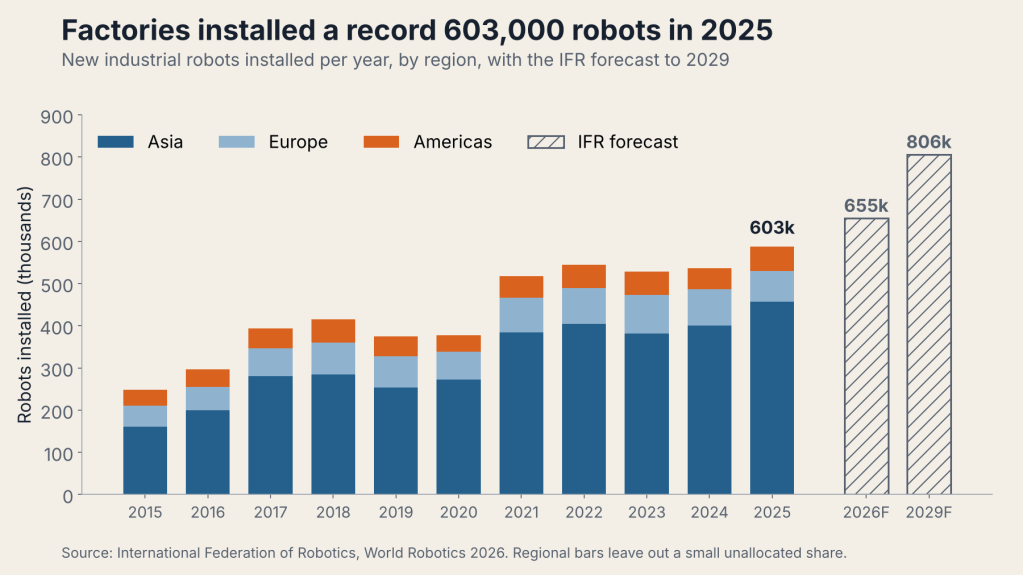
    Stacked bar chart of yearly industrial robot installations by region, from about 254,000 in 2015 to a record 603,000 in 2025, with IFR forecasts of 655,000 in 2026 and 806,000 in 2029.
    Factories installed a record 603,307 industrial robots in 2025.

    By the end of 2025 about 5 million industrial robots were at work worldwide, more than double the number seven years earlier. China installed 59% of last year’s new robots. South Korea runs 1,220 robots per 10,000 manufacturing workers, against a world average of 132. The International Federation of Robotics expects installations to reach 655,000 this year and 806,000 in 2029.

    2022 onward: work that plans itself

    In the past the man has been first; in the future the system must be first.

    F. W. Taylor, The Principles of Scientific Management, 1911

    Taylor’s most uncomfortable sentence has never been more literal. Generative AI drafts the work: instructions, FMEAs, code and reports from plain language. Agentic AI goes further and plans and acts across systems, in scheduling, maintenance, quality containment and purchasing. For the first time, the system can do the planning that Taylor took away from the worker.

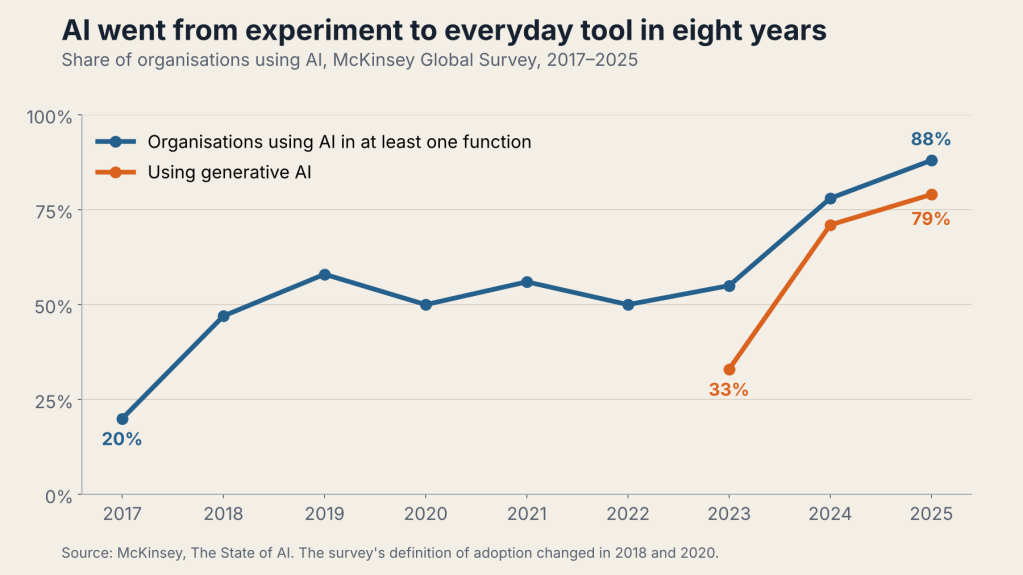
    Line chart: share of organisations using AI rises from 20% in 2017 to 88% in 2025; generative AI use rises from 33% in 2023 to 79% in 2025.
    Organisations using AI, 2017–2025. McKinsey’s survey definition changed in 2018 and 2020.

    Adoption is fast; scaling is not. In Deloitte’s AI in Manufacturing 2026 study of manufacturers in Switzerland and Germany, 84% report measurable value from AI, yet only about one use case in five has been scaled across sites. In Deloitte’s wider enterprise survey, 23% of companies already use agentic AI at least moderately and 74% expect to within two years. Gartner, meanwhile, expects more than 40% of agentic AI projects to be cancelled by the end of 2027.

    Humanoid robots tell the same story at a smaller scale.

    Bar chart drawn to scale: 603,307 industrial robots, about 250,000 professional service robots and about 7,000 full-size humanoids sold worldwide in 2025.
    Humanoids are in the plant, but not yet at scale.
    • Paid work. Agility’s Digit robots work at GXO warehouses and, since February 2026, at Toyota’s plant in Canada, on robots-as-a-service contracts.
    • Pilot. Figure’s robots logged more than 1,250 hours on BMW’s line in Spartanburg; a new model, Figure 03, arrived there in June 2026.
    • Planned. Boston Dynamics launched the production version of Atlas in January 2026; Hyundai plans to use it in its US plant from 2028.
    • Trials. Mercedes-Benz is testing Apptronik’s Apollo for logistics in Berlin.

    The pattern again

    In 1911 the stopwatch raised output and workers struck. In the 1980s and 1990s, many companies copied lean tools without the thinking behind them and stalled. In 2026 most firms run AI pilots, and few have scaled them. Each time, the technical half was ready before the human half.

    Three scenarios for the 2030s

    Two things are uncertain: how fast the technology matures, and how well the change is managed. Crossing them gives three plausible paths. These are scenarios, not forecasts.

    • A, shared gain: capable technology and well-managed change. Productivity rises and is shared.
    • B, narrow gain: capable technology and unmanaged change. Gains go to a few firms and countries.
    • C, slow grind: the technology or its adoption stalls. Pilots multiply and little changes.
    AngleA · Shared gainB · Narrow gainC · Slow grind
    BusinessAutomation bought as a service; small plants join in and freed capacity goes into improvement.Large firms automate first; mid-size suppliers are squeezed between capital cost and price pressure.Pilots multiply and few scale; the cost of AI arrives before the return.
    ConsumersCustom products at mass-production prices, made closer to home.Cheaper goods from fewer makers; choice narrows.Little visible change; prices follow energy and materials more than labour.
    LabourOperators supervise cells of robots and agents; pay follows productivity, as Taylor promised.Routine planning and handling jobs go first; the skills gap widens.Jobs change slowly; the shortage of skilled technicians stays the real limit.
    SocietySafer work and shorter hours; ageing societies keep producing with fewer workers.Regions split into winners and losers; tax systems built on wages come under strain.Promises outrun results; trust falls and regulation tightens.
    WorldTechnology spreads; production moves closer to demand and emerging economies leapfrog.Robots, chips and AI models concentrate in a few countries; the low-wage export ladder narrows.Labour-cost differences still decide where things are made.

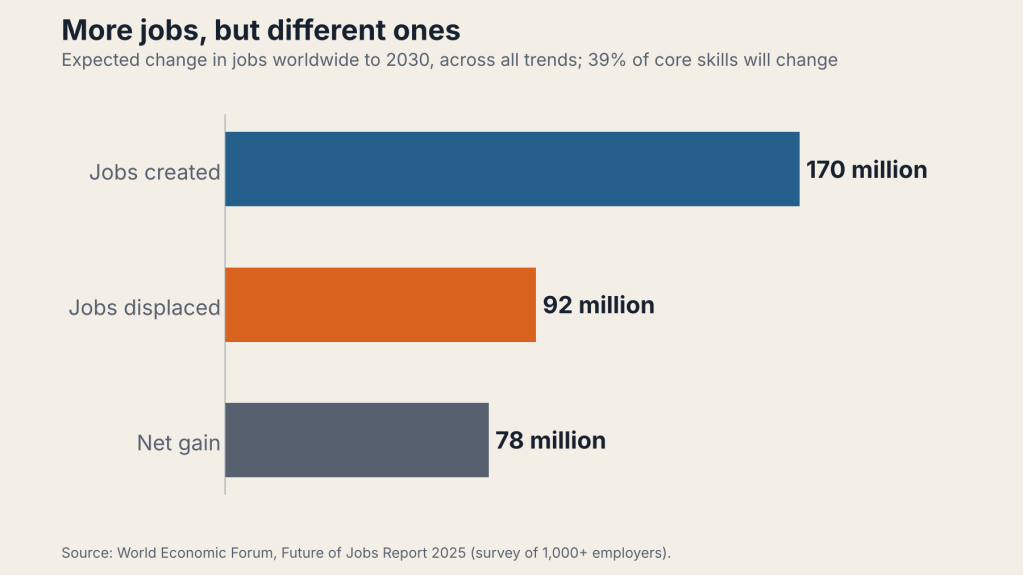
    For labour, the World Economic Forum’s employer survey points to more jobs overall, but different ones, with 39% of today’s core skills expected to change by 2030.

    Bar chart: 170 million jobs created, 92 million displaced and a net gain of 78 million worldwide by 2030.
    Expected change in jobs worldwide to 2030, across all trends.

    The signals I will be watching:

    • The share of AI use cases scaled beyond one site, today about one in five.
    • Where productivity gains go: wages, working hours, prices or profits.
    • Whether humanoid deployments move from single-digit pilots to fleets with published cost and reliability data.
    • How concentrated robot installations stay, with China at 59% today.

    What to take away

    1. Engineer the work and its acceptance together.
    2. Share the gain, or expect resistance. Ford learned it in 1914.
    3. Manage the change before the pilot, not after.

    Taylor asked for prosperity on both sides and a mental revolution on both sides. More than a century later, with agents doing the planning, both conditions still hold. Which scenario is your plant heading for? Tell me in the comments.


    Sources: F. W. Taylor, The Principles of Scientific Management (1911) and testimony to the US House Special Committee (1912); H. Ford, My Life and Work (1922); D. Raff and L. Summers, “Did Henry Ford Pay Efficiency Wages?”, Journal of Labor Economics (1987); Model T Ford Club of America production and price records; W. E. Deming, Out of the Crisis (1986); T. Ohno, Toyota Production System (1988); J. Krafcik, “Triumph of the Lean Production System” (1988); J. Womack and D. Jones, Lean Thinking (1996); M. Hughes, Journal of Change Management (2011); International Federation of Robotics, World Robotics 2026; McKinsey, The State of AI (2025); Deloitte, AI in Manufacturing 2026 and State of AI in the Enterprise 2026; Gartner (June 2025); World Economic Forum, Future of Jobs Report 2025; company announcements from Agility Robotics, GXO, Toyota, Figure, BMW Group, Boston Dynamics, Hyundai and Mercedes-Benz.

    Charts drawn for this post from the sources above. Photos: Frederick W. Taylor, public-domain portrait; Highland Park, 1914, Ford Motor Company.