In December 2013 I put together a short deck called Scientific Management & Change Management. Twelve years later I went back to it. Some dates were wrong, key figures were missing, and the link the title promised, between the stopwatch and the people standing next to it, was never drawn.
This is the rebuilt version, checked against the original sources and carried forward to the AI agents and humanoid robots now arriving in factories. The argument fits in one sentence: every leap in how work is engineered has set off a crisis in how people accept it. Change management is not a soft add-on to industrial engineering. It grew out of industrial engineering’s first failures.
1881–1911: the stopwatch
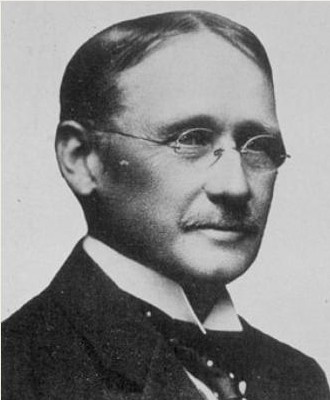
In 1881, at the Midvale Steel Company in Philadelphia, Frederick W. Taylor began timing work with a stopwatch. He published Shop Management in 1903 and The Principles of Scientific Management in 1911. “Taylorism” and “scientific management” are two names for the same system, not two stages of it.
The principal object of management should be to secure the maximum prosperity for the employer, coupled with the maximum prosperity for each employé.
F. W. Taylor, The Principles of Scientific Management, 1911
His four principles are usually quoted in a softened form. In plain terms they were:
- Science. Develop a science for each element of the work, replacing rule of thumb.
- Selection. Select workers scientifically, then train and develop them.
- Cooperation. Cooperate with workers so the work follows the science.
- Division. Management takes over the planning; workers execute. This is the principle that caused the trouble.
Taylor was not alone. Frank and Lillian Gilbreth broke work into basic motions, and Lillian brought psychology into management. Henry Gantt made schedules visible with the chart that still carries his name. Henri Fayol defined management itself in 1916: plan, organise, command, coordinate, control. And in 1908 Hugo Diemer started the first industrial engineering degree, at Penn State.
1913: flow at mass scale
At Highland Park in 1913, Henry Ford added the moving assembly line. Chassis assembly time fell from about twelve and a half hours to 93 minutes. The results show up in the numbers: Model T production rose from about 10,700 cars in 1909 to 2 million in 1923, while the price of the runabout fell from $825 to $260.
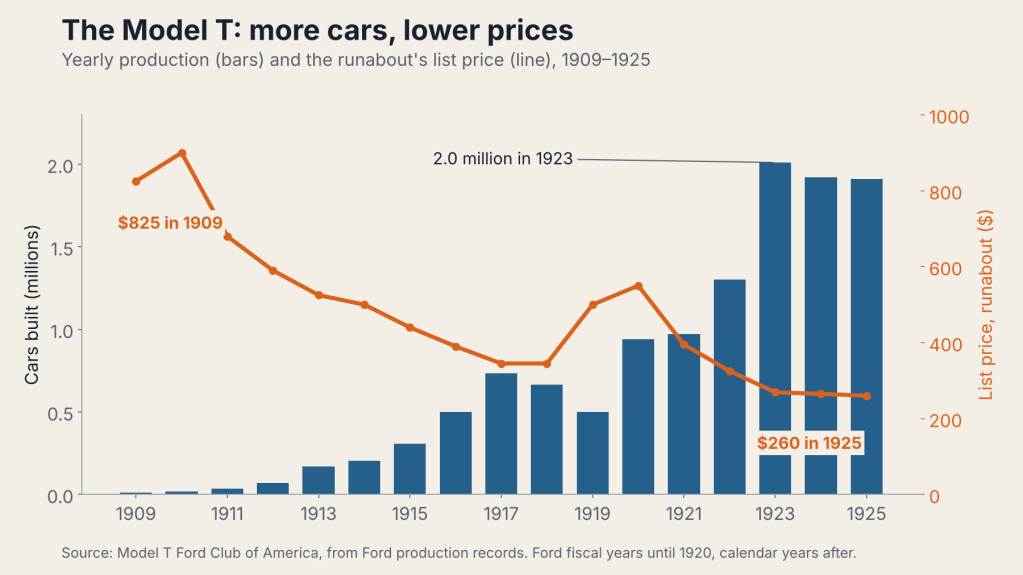
Ford’s contribution was flow and standardisation. Production cells, which my old deck wrongly filed under Ford, came later, from group technology and Toyota.
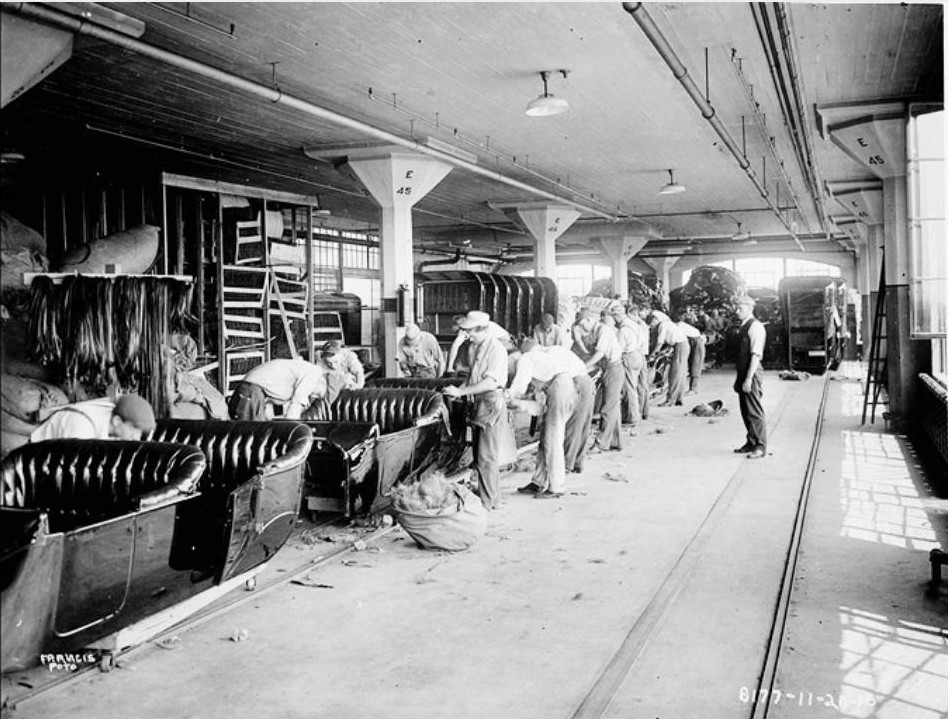
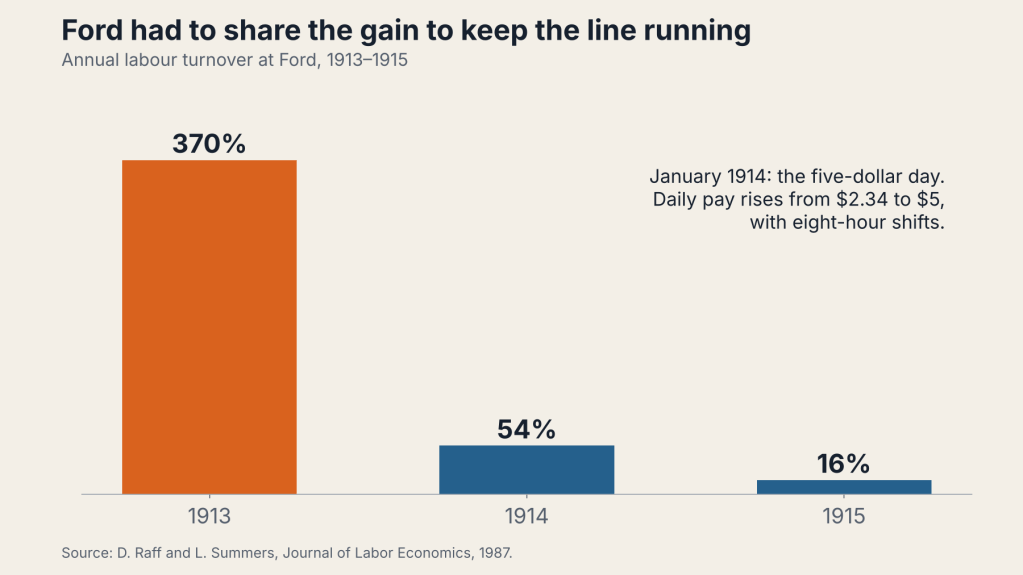
The line had a cost that rarely makes the textbooks. In 1913 Ford’s labour turnover was 370%: the company hired around 50,000 people to keep about 13,600 jobs filled. In January 1914 Ford more than doubled daily pay, from $2.34 to the famous five dollars, and cut shifts to eight hours. Turnover fell to 54% in 1914 and 16% in 1915.
1911–1932: the backlash
Scientific management raised output and lost the workforce. In August 1911, molders at the Watertown Arsenal walked out over the stopwatch. In January 1912 Taylor spent four days defending his system before a special committee of the US House of Representatives. From 1915 Congress barred stopwatch time study in government arsenals, a ban renewed until 1949. Then, from 1924 to 1932, the Hawthorne studies at Western Electric suggested that attention and group norms move output as much as lighting and pay do.
Taylor’s own answer, given to that committee, is the most important line in this story:
Without this complete mental revolution on both sides scientific management does not exist.
F. W. Taylor, testimony to the US House Special Committee, January 1912
Change management was inside the method from the start. It simply took decades to be treated as a discipline of its own.
The human side becomes a discipline
- 1947, Kurt Lewin: unfreeze, change, refreeze.
- 1960, Douglas McGregor: Theory X and Theory Y, two opposite assumptions about why people work.
- 1969, Elisabeth Kübler-Ross: the stages of grief, later adapted by managers into the change curve.
- 1995, John Kotter: eight steps for leading change.
- 2006, Jeff Hiatt (Prosci): ADKAR, which treats change one person at a time.
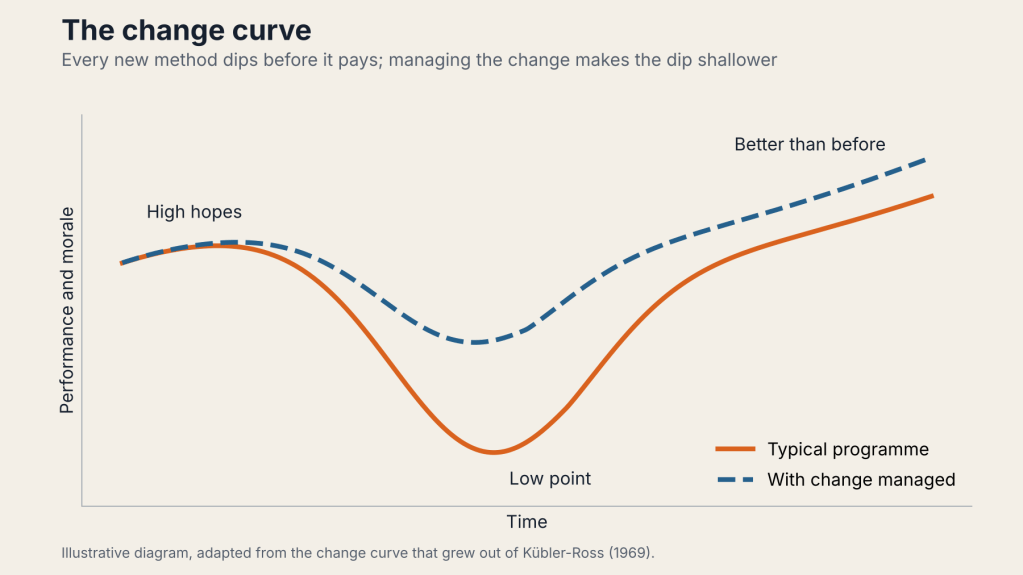
One caution: the line you will often read, that 70% of change programmes fail, has no solid evidence behind it. Mark Hughes traced its sources in 2011 and found none that supports a universal figure. The curve is real enough; the statistic is folklore.
Variation and waste: quality and lean
A parallel line ran through statistics. Walter Shewhart drew the first control chart at Western Electric in 1924. W. Edwards Deming taught statistical control in Japan from 1950, and Joseph Juran published his Quality Control Handbook in 1951. Bill Smith framed Six Sigma at Motorola in 1986, and GE spread it worldwide from 1995. Six sigma means 3.4 defects per million opportunities.
Drive out fear.
W. Edwards Deming, point 8 of 14, Out of the Crisis, 1986
Even the statistician’s rule for quality turns out to be a rule about people.
In Japan, Taiichi Ohno spent almost three decades from 1948 building the Toyota Production System on two pillars: just-in-time, which makes only what is needed when it is needed, and jidoka, which stops the line the moment a defect appears.
The basis of the Toyota production system is the absolute elimination of waste.
Taiichi Ohno, Toyota Production System, 1988 (Japanese original 1978)
The word “lean” arrived only in 1988, coined by John Krafcik at MIT. The Machine That Changed the World took the idea global in 1990, and Lean Thinking set out its five principles in 1996: value, value stream, flow, pull and perfection. Perfection is a direction to move in, never a state you reach.
1961–2025: machines that follow programs
Unimate, the first industrial robot, started work at General Motors in 1961. The first programmable logic controller shipped in 1969. ERP and MES systems put the plant’s data in one place in the 1990s, and Industrie 4.0 was launched at Hannover Messe in 2011.
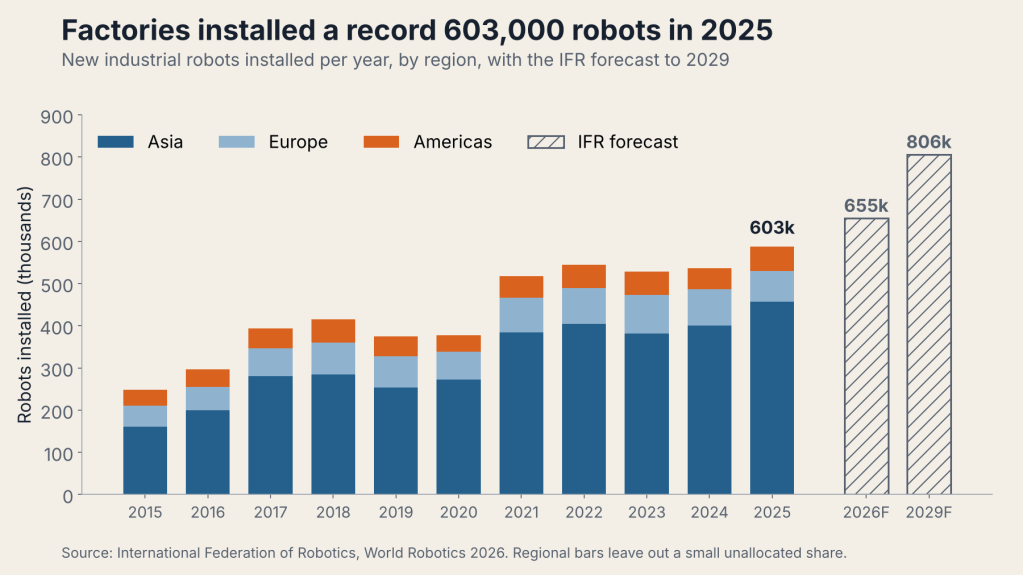
By the end of 2025 about 5 million industrial robots were at work worldwide, more than double the number seven years earlier. China installed 59% of last year’s new robots. South Korea runs 1,220 robots per 10,000 manufacturing workers, against a world average of 132. The International Federation of Robotics expects installations to reach 655,000 this year and 806,000 in 2029.
2022 onward: work that plans itself
In the past the man has been first; in the future the system must be first.
F. W. Taylor, The Principles of Scientific Management, 1911
Taylor’s most uncomfortable sentence has never been more literal. Generative AI drafts the work: instructions, FMEAs, code and reports from plain language. Agentic AI goes further and plans and acts across systems, in scheduling, maintenance, quality containment and purchasing. For the first time, the system can do the planning that Taylor took away from the worker.
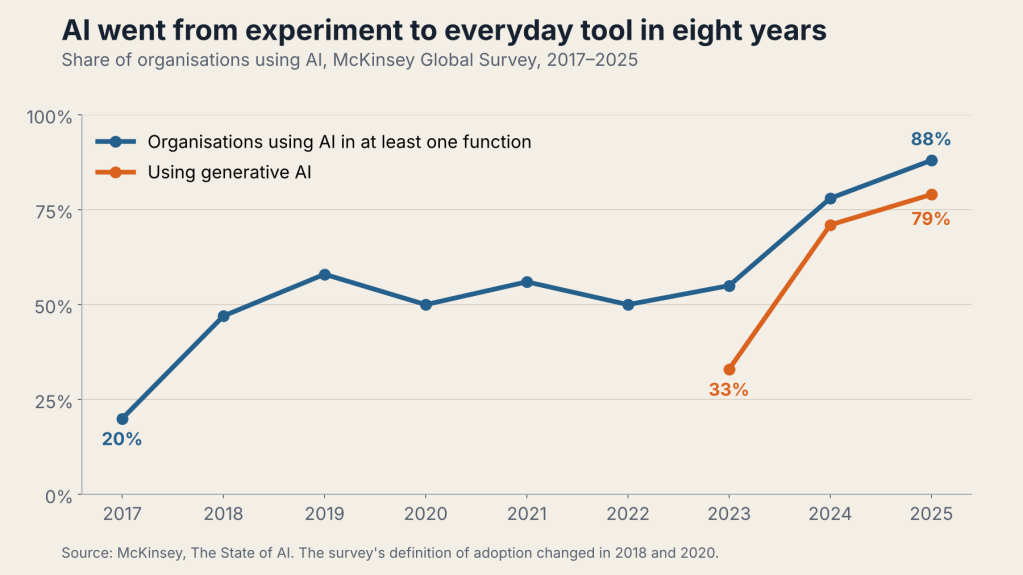
Adoption is fast; scaling is not. In Deloitte’s AI in Manufacturing 2026 study of manufacturers in Switzerland and Germany, 84% report measurable value from AI, yet only about one use case in five has been scaled across sites. In Deloitte’s wider enterprise survey, 23% of companies already use agentic AI at least moderately and 74% expect to within two years. Gartner, meanwhile, expects more than 40% of agentic AI projects to be cancelled by the end of 2027.
Humanoid robots tell the same story at a smaller scale.
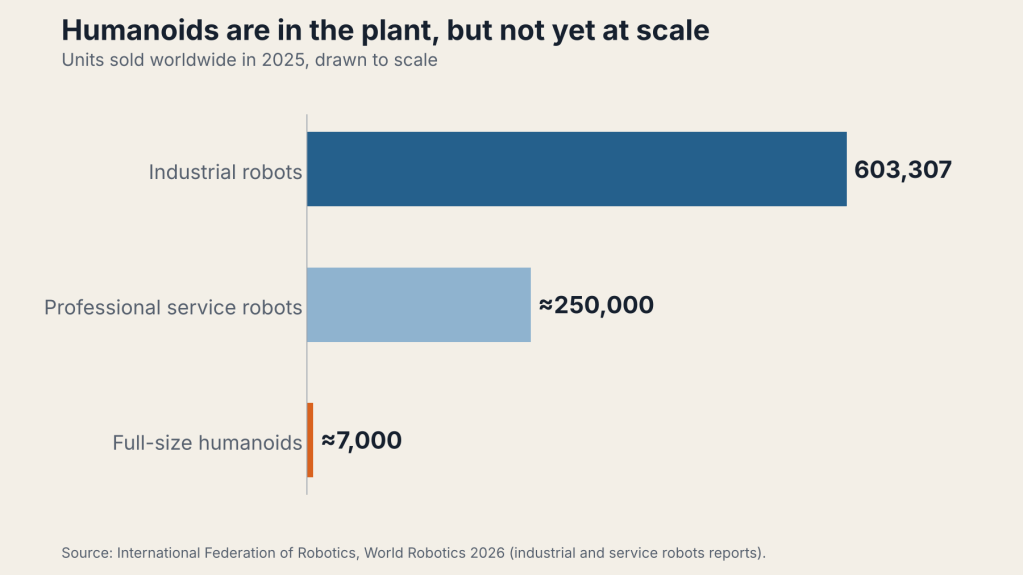
- Paid work. Agility’s Digit robots work at GXO warehouses and, since February 2026, at Toyota’s plant in Canada, on robots-as-a-service contracts.
- Pilot. Figure’s robots logged more than 1,250 hours on BMW’s line in Spartanburg; a new model, Figure 03, arrived there in June 2026.
- Planned. Boston Dynamics launched the production version of Atlas in January 2026; Hyundai plans to use it in its US plant from 2028.
- Trials. Mercedes-Benz is testing Apptronik’s Apollo for logistics in Berlin.
The pattern again
In 1911 the stopwatch raised output and workers struck. In the 1980s and 1990s, many companies copied lean tools without the thinking behind them and stalled. In 2026 most firms run AI pilots, and few have scaled them. Each time, the technical half was ready before the human half.
Three scenarios for the 2030s
Two things are uncertain: how fast the technology matures, and how well the change is managed. Crossing them gives three plausible paths. These are scenarios, not forecasts.
- A, shared gain: capable technology and well-managed change. Productivity rises and is shared.
- B, narrow gain: capable technology and unmanaged change. Gains go to a few firms and countries.
- C, slow grind: the technology or its adoption stalls. Pilots multiply and little changes.
| Angle | A · Shared gain | B · Narrow gain | C · Slow grind |
|---|---|---|---|
| Business | Automation bought as a service; small plants join in and freed capacity goes into improvement. | Large firms automate first; mid-size suppliers are squeezed between capital cost and price pressure. | Pilots multiply and few scale; the cost of AI arrives before the return. |
| Consumers | Custom products at mass-production prices, made closer to home. | Cheaper goods from fewer makers; choice narrows. | Little visible change; prices follow energy and materials more than labour. |
| Labour | Operators supervise cells of robots and agents; pay follows productivity, as Taylor promised. | Routine planning and handling jobs go first; the skills gap widens. | Jobs change slowly; the shortage of skilled technicians stays the real limit. |
| Society | Safer work and shorter hours; ageing societies keep producing with fewer workers. | Regions split into winners and losers; tax systems built on wages come under strain. | Promises outrun results; trust falls and regulation tightens. |
| World | Technology spreads; production moves closer to demand and emerging economies leapfrog. | Robots, chips and AI models concentrate in a few countries; the low-wage export ladder narrows. | Labour-cost differences still decide where things are made. |
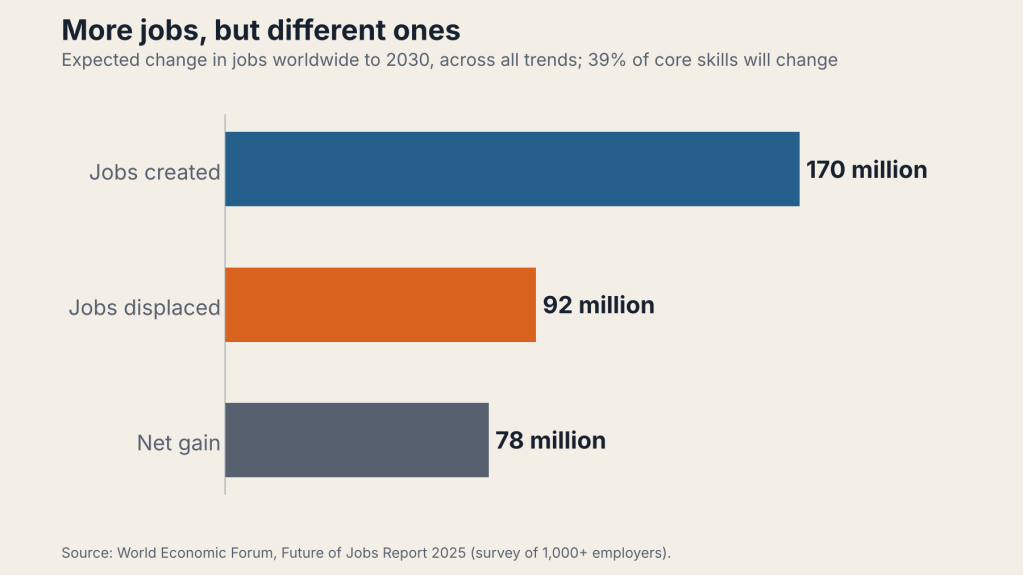
For labour, the World Economic Forum’s employer survey points to more jobs overall, but different ones, with 39% of today’s core skills expected to change by 2030.
The signals I will be watching:
- The share of AI use cases scaled beyond one site, today about one in five.
- Where productivity gains go: wages, working hours, prices or profits.
- Whether humanoid deployments move from single-digit pilots to fleets with published cost and reliability data.
- How concentrated robot installations stay, with China at 59% today.
What to take away
- Engineer the work and its acceptance together.
- Share the gain, or expect resistance. Ford learned it in 1914.
- Manage the change before the pilot, not after.
Taylor asked for prosperity on both sides and a mental revolution on both sides. More than a century later, with agents doing the planning, both conditions still hold. Which scenario is your plant heading for? Tell me in the comments.
Sources: F. W. Taylor, The Principles of Scientific Management (1911) and testimony to the US House Special Committee (1912); H. Ford, My Life and Work (1922); D. Raff and L. Summers, “Did Henry Ford Pay Efficiency Wages?”, Journal of Labor Economics (1987); Model T Ford Club of America production and price records; W. E. Deming, Out of the Crisis (1986); T. Ohno, Toyota Production System (1988); J. Krafcik, “Triumph of the Lean Production System” (1988); J. Womack and D. Jones, Lean Thinking (1996); M. Hughes, Journal of Change Management (2011); International Federation of Robotics, World Robotics 2026; McKinsey, The State of AI (2025); Deloitte, AI in Manufacturing 2026 and State of AI in the Enterprise 2026; Gartner (June 2025); World Economic Forum, Future of Jobs Report 2025; company announcements from Agility Robotics, GXO, Toyota, Figure, BMW Group, Boston Dynamics, Hyundai and Mercedes-Benz.
Charts drawn for this post from the sources above. Photos: Frederick W. Taylor, public-domain portrait; Highland Park, 1914, Ford Motor Company.

